Lynch Poo-Poos Peak Oil

Michael Lynch, a long term consultant to the oil industry and Hubbert Peak debunker for over two decades published another Op Ed piece in the New York Times on Friday, February 25, 2011.

Since at least 1989, Mr. Lynch has made a career of poo-pooing any concept that oil supplies might be finite and that we might find production capability dropping as demand continues to rise.  (This, in a nutshell,  is what the pat phrase “peak oil” means.)  References: In a 1998 articles he refers to his work in 1989. A search engine check yields many hits.

In the NYT article, above, his background idea is that discussing the end of easily obtainable oil is like screaming that the sky is falling.  His hidden subtext is: Such things are done by people who are foolish, or have a hidden agenda.  His explicit points are:  There is a miscommunications in the size of Saudi reserves, or whether the estimates were for proven reserves or estimated reserves.  Or whether the Wikileak revelations some time ago was really new.

Everyone:  the 2011, or 2010 (or 2007) Wikileak documents were not all that new.  Information about Saudi capacity did not just pop up recently.  This information was available in 2007 in over-the-counter mags like Atlantic Monthly!  See my previous post for details.  In 2004, Matthew Simmons, founder of the Simmons & Company, International, issued an analysis (report by Institute for Analysis on Global Security on his analysis) that Saudi Arabia could not continue increasing oil production. Mr. Simmons’ concern about energy security dates back to the oil embargo crisis that entangled the US and Saudi Arabia in 1973.  Lynch and Simmons are old sparring opponents.

Hidden in Big Numbers. Let’s use Lynch’s numbers and put the 270 billion barrels of proven reserves, 600 billion in potential reserves,  into a usage perspective.  There is an unexpected trap right here before we start, because “billion” means U.S. billion (European thousand million, not the European billion).

“Billion” is a dumb unit because it is easy to misunderstand.  Use the ugly  “giga” prefix for 109 instead … as in 4 GB memory.  This is equally ugly in English, French, Spanish German, Russian, Chinese, etc.  No one feels slighted because all ears are offended.

Giga-barrels (Gbbl) sounds big, 600 Gbbl sounds impressive.  Here is how the issue is hidden – How can something so big ever be a problem?  Let’s calibrate our thinking:  humans use is about 85.5 M bbl each day, about 31.2 Gbbl each year.

Constant use, CU: The constant use lifetime for the reservoir is the time interval where the petroleum is removed from the reservoir at a steady rate.  The proven Saudi reserve, 270 Gbbl, would last YP = 270/31.2 = 8.6 CU years. The total estimated reserve of 600 Gbbl would last only 10.6 years longer (YE = 19.2 CU yr).  And this is if oil is used at the same bbl/day value each and every day until we hear that straw make its empty-bottle sucking sound.

Constant rate, CR: The constant-rate time happens when the demand forces production to grow at a constant rate of increase.  We tend to think in terms of the CU time frame, but data show that resources are withdrawn from the reservoir through  the CR mode for as long as technically possible.  This is another way to say that the growth is exponential.

The CR time formula was discussed in my previous peak oil post.  Anyone with a calculator can use it:  T = ln(1 + r*Y*f)/r.  Here, r is the average annual growth rate, Y is the CU time for the reservoir, f is the fraction of the reservoir used (f = 1 means  completely used up), and r is the rate (0.04 would mean 4%/year).

Good to the very last drop. If the Saudi’s were the only petroleum producer for the world, and the rate of increase in consumption is 4% annually, then for its proven reserve,  Y = 8.6, r = 0.04, and the entire reservoir (f = 1) would last TP1 = ln(1+0.04*8.6*1)/0.04  …about 7.4 CR years.  The estimated recoverable reserve would be drained in TE1 = ln(1+0.04*19.2*1)/0.04  …about 14¼ CR years.

Half full or half empty? A constant growth rate of supply cannot be sustained right up to the last drop in the reservoir.  Usually, the end of CR growth is considered as the time to the half empty point (f = 0.5).  By the standard Hubbert model, after that, growth flattens out;  after painful and expensive efforts to resist, it begins to fall.  This is the Peak Time, T1/2.  For Saudi proven reserves (as only world supplier)   TP1/2 = ln(1+0.04*8.6*0.5)/0.04  … about 4 CR years.  For Saudi estimated reserves (as sole world supplier) TE1/2 = ln(1+0.04*19.2*0.5)/0.04  … about 8 CR years.

Not an issue?  Do you expect to be dead and gone in the next 4 to 8 years?

Not really a fair question because our exponential growth model values assume that Saudi Arabia is the only petroleum provider in the world.  Not fair also, because we did not start our calculations from an untapped field, but from the Saudi resource base of about 2006. The reserve is far from virgin and the true question is whether or not it has reached the half empty point.

This is not a discussion of 40% errors.  Such are trivial concerns, representing mere months of world demand, a year or two at most.   Exponential growth of the demand curve means the Saudi fields must be capable of relentless expansion of their product.  Are they?

The Saudi leaks and interviews indicate that they might not be capable of exponential growth in production.  If not, then they have already reached their peak value.  From here on out, petroleum extraction will be more technically sophisticated, more difficult, more expensive. The question “Has Saudi oil peaked?” is more meaningfully phrased “Can Saudi fields supply oil with a relentless growth in production of 3-5 % each year?”

Key Question: Can Saudi production demonstrate exponential growth over the next several years to supply US, China Europe, India and all other locations?

  1. Yes.  Then they are not yet at Peak production, they will continue to play a major role in world politics as it has unfolded for more than a century.
  2. No.  Then they have hit the peak production.  Gbbl/yr will be constant in the near term, provided huge monies are spent,  but ultimately must slowly decrease.

Answer 1. the world will continue on as it has, with US slipping while industrial leaders continue to ship manufacturing and research capabilities abroad;  former “third world” countries enter into their own strength.

Answer 2. the world is on the cusp of a massive transition from the one paradigm for living into another based on some unpredictable political and social order.  “Paradigm shift” is one of the ways of describing the chaotic jump in complexity theory from one strong attractor to a different one.

click for all our discussions about oil resources

I have been told that the Chinese have a curse:  May you live in interesting times.  Such a curse may not actually exits, but depending on which answer is correct, life in this tender new century may become very interesting and very soon.

Charles J. Armentrout,   Ann Arbor
2011 Feb 26;  Minor Modification  2011 Jun 03

Listed under   Natural Resources   …thread   Natural Resources > Oil
Have a comment? Click on the title of this post, go to bottom, let us know.
Related posts: Click the INDEX  button under the Banner picture

Posted in Natural Resources | Tagged , , , | Leave a comment

Does a Gold Standard make sense?

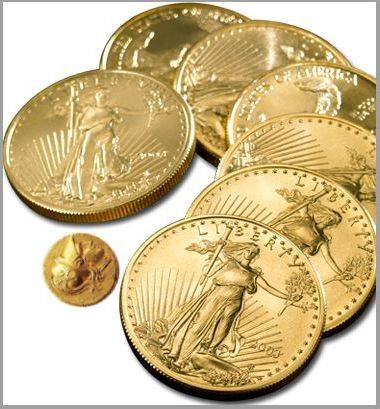
GoldCoins_imgLast week (2011 Feb 06-12) the question of backing the US dollar with something of value rose up yet again. Last Tuesday, Paul Ryan (Rep. WI) asked (or rather lectured) Ben Bernanke why the price of gold was rising, or conversely, the value of the dollar was dropping. He stated that some would see this “as a vote of no confidence against fiat currencies.” Fiat currencies are those that float, that is, are evaluated in reference to each other, not to any invariant commodity, like gold. This was such an event that by week’s end (Friday), the New York Sun had an editorial on it, and Paul Krugman featured him in his excellent column in the New York Times.   Gold-denominated currency is again in the news. Not for the last time in this congressional session, I fear. My thinking (below) is that metals denominated currency is a bad idea and not the way to go.

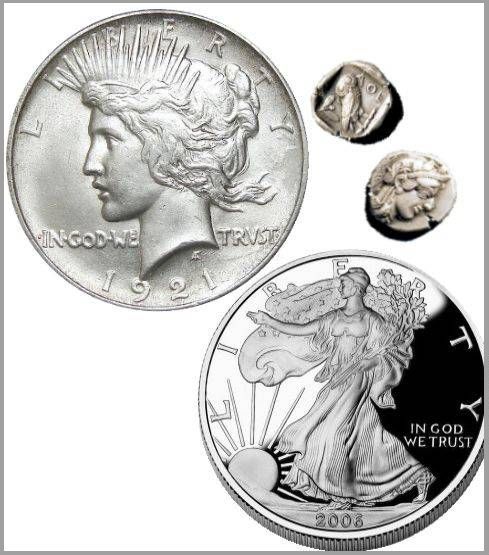
SilverCoins_imgSilver and gold both have been used to support the value of currency, on and off, at various times. In the 1700’s, the gold to silver valuation was about 15:1, reflecting the centuries long nearly constant price ratio of these metals, and almost the natural abundance ratio (1:17) of the two metals . This led to the metal standard: Sometimes gold denominated the currency, sometimes silver, sometimes both at the same time (bimetallic standard). Republican Abraham Lincoln (1862) was the first president to issue paper currency without any metal backing (the “green back,” to pay war debts). Democrat Franklin D. Roosevelt (1934) broke the link between a gold denominated dollar and domestic currency (but silver backed the dollar at home and international debts were still backed by gold). Democrat Lyndon Johnson (1964) ended issuance of Silver Certificate dollars and the last day one could convert a dollar to silver bullion was 1968 June 24. Republican Richard Nixon (1971) finally ended any and all connection between the US dollar and any metal of any sort.

click for a list of LastTechAge posts on monetary policy

The history of monetary standards is a tangle of the various political parties, and various monetary support strategies (gold, silver, other, and even none: where the value of the dollar is worth exactly one dollar).

The heart of the matter. A math model is developed in the Appendix (this posting) that shows how to relate inflation in a country to its currency. Only if you can denominate the currency by a commodity that does not change in intrinsic value over time, can inflation and currency evaluations may be done with confidence. If the basis for the denomination is not invariant, no accurate relation can be made determined. Our task – identify an invariant item to base our currency on. If this were possible, then our currency would be invariant, too.

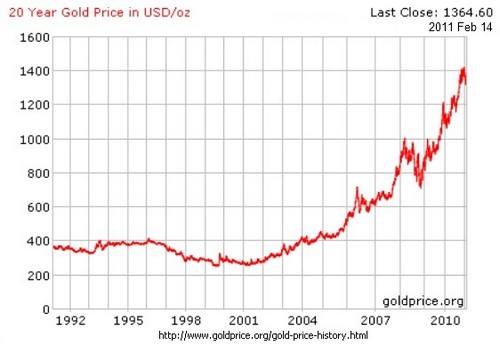
Gold prices 1991-2001If gold is to be our standard, then consider: it has risen from a 2001 starting point of PS(2001)=$300/oz to a current 2011 value of PS(2011)=$1370/oz in a classic exponential rise. This happened in the last 10 years with almost no record of inflation in other goods. I will return to this fascinating graph later, in a political posting. Without matching inflation, gold could not be even approximately invariant.

This last observation means gold is not a good candidate to denominate the dollar, since it is not steady enough. (Sorry, Rep. Ryan.) We can use something as a monetary basis only if its intrinsic value does not vary ever. If we can find something invariant, the math says that we should definitely back currency with it, whatever it might be.

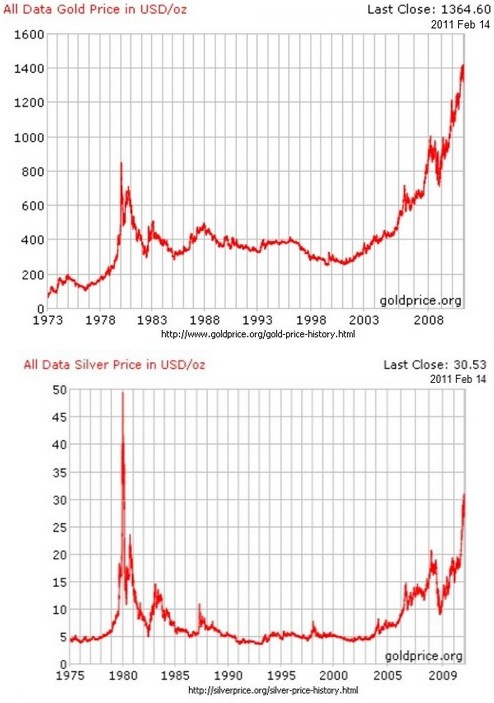
Gold/Silver comparisons 1975-2011The gold/silver ratio was nearly invariant for almost 300 years (1600-1900) and there was a lot of support for a bimetallic basing of all currency. Unfortunately, that was a unique historical epoch and the ratio wiggled about during the last century. look at these two graphs, set on the same time scales for comparison. These graphs are not corrected to 2011 dollars. If this had been done, the 1980 spikes would be much higher.

The oscillations of the two metals means that they cannot be used as a currency base … we must not denominate the dollar on anything this volatile! Those who would do so are setting the stage for monstrous scams that will rob us all, everyone but the Madoffs or Hunt Brothers in our population.

Proposals for an invariant: Count the many ways: If not (1) gold or silver, there must be some other invariant we could use … (2) The Coca-Cola standard: I remember being lifted high so that I could put my nickel into the slot and get a wonderfully cold bottle of “coke.” Now, you can pay $1.35 for a bottle anywhere. At one time I used this as a defacto inflation measure. Volumes changed, corn syrup replaced expensive sugar, other changes happened. No, soft drinks are not a good inflation indicator.

(3) Price of a new car for a middle class family of 4? About $200 in 1910, maybe $30,000 today. But now, the car is not manufactured in the US, it is just assembled here (read… insert part A into part B, weld to part C…). Much has changed and the cost base is controlled outside of our own borders. Too, the goodies expected for a standard car are much different… We cannot use this vehicles a reasonable inflation gauge. (4) The median week’s wage used to buy a pair of shoes. True for centuries. 40 years ago shoe repair shops were everywhere, it was cheaper to repair than to replace. Not now, for many shoes. Scratch median weekly wage. (5) Cost of a party dress? 40 years ago, most were made in the US and pricing was part of the local financial feedback loop that let us tie inflation to money. (6) How about a standard meal? (7) Or the price of ASTM 1010 steel? (8) Is a man’s dress shirt actually invariant? (9) What about a middle class income? This actually begs the question (means: forces the test) on what is meant by “middle class.” A middle class wage earner in the 1950’s could support a family of four on 1 salary and send the children to a university. Now a family of 4 with with median income from two salaries cannot send their children to a university. So – don’t go denominating your currency on a middle class family in the population.

We manufacture almost nothing nowadays. This breaks the loop that lets us use most fungible items as standards. Low prices, currently the norm in the US, are not due to local inflation and the value of one USD.  Things that control costs are mainly the nearly slave-labor wages paid in Southeast Asia and China. Oh yes, and also are the working environments that have no expensive worker safety enforcements such as our national OSHA, EPA and other regulator/enforcement agencies. Our (10) cell phones and computers are cheap because China makes them and supplies most of the World’s volume of rare earth minerals. Workers must live in the toxic mining environment; short painful life = cheap chips for the rest of us. Makes good business sense, maybe, but rare earth minerals would be a lousy commodity to denominate the US dollar.

Ten failed proposals. Can you identify an invariant quantity that, if used, would allow currency, itself, to have a constant value?

Reconsider: What are we trying to do here? Denominating currency by an invariant quantity would let us evaluate inflation/currency relationships. Instead, if we wanted to compare different currencies, it would be much better to float all currencies. This lets the free and unobstructed marketplace do the comparisons. (How could Rep. Ryan not like that?)  Restate: to compare different currencies, they should all float against each other. Invariant backing is only useful to understand inflation.

Two invariants are needed. The scientific/engineering truth is, we actually must use at least two commodities that never change, so that we can calibrate (verify) one against the other. At last! We would be able to evaluate currency without regard for local inflation.

We really do need the 2 invariants. If we tie currency to only one we will lose control: A single invariant denominator for the dollar would not allow consistency checking; it would allow circular reasoning that could cause rocketing highs and massive depressions. The charts show that gold and silver have a malleable value and are no longer constants; they make lousy dollar metrics.

This is unfortunate.  I cannot identify even one invariant quantity, let alone two.

Denominating currency with fungible goods will lead to the centralization of wealth and opportunity, ultimately the return to global feudal societies. This is because market players with massively high wealth could (therefore would) manipulate the denominating item and end up controlling great portions of the currency pool.

Every post needs a bottom line. Here is mine: Smooth sentences with pretty words are easy to bend and twist into reasonable sounding traps. My own analysis (this post), says that gold denominated dollars not not any kind of way to go. This would, however, be good for speculators, or for those planning to corner the metals market. In other words, it is a good way for a fraction of a percent of our society to make their family fortune, but it would speed the ruin of our society.  Krugman clearly wins on the gold standard issue.

Reality is its own thing. Reality operates as it will, not as ideologues order.

Charles J. Armentrout, Ann Arbor
2011 Feb 11,  Minor additions 2011 Jun 03
Listed under   Economics
Have a comment? Click on the title of this post, go to bottom, let us know.
Related posts: Click the INDEX button under the Banner picture

________________________________________________________________

To refer to value, you must use some kind of standard along with arithmetic or algebra.

When you study inflation in school, you read that the price for an item will rise over time. If Country A experiences 10% annual inflation (0.1 rise in price per year) then something costing 10 markers this year will cost 11 next. This continuous process is easily measured, and unquestionably occurs.

Inflation is another of the exponential processes that I have been discussing (see Chess Fable and Rabbit Growth). It is clearly exponential because the amount by which price of an item increases next year depends on its current price this year. It is an example of unconstrained growth and clearly cannot continue forever; any extended period will lead to the destruction of the country, one way or another.

The math class: You are sometimes asked: if there was measurable inflation, how did the currency decrease in value? The instructor means – if price P in dollars/item rises as P=P0e rt (standard economic inflation formula for prices) then it should be obvious that the currency’s value falls with the negative rate of inflation: V=V0e–rt where V is the value of the monetary unit (items per dollar), and V0 is its value when the clock started (t=0). If the price starts to climb, it must be because the currency is dropping in value – you might have to define something like a “typical average item” to place a value on money, still, this argument probably feels right. But, is it so?

People get trapped in verbal embellishments. The speaker sets up both the situation and the discussion so that one’s sensitivity is numbed. Amazing hogwash can verbally pass as truth. Math is the tool to start from somewhere and automatically finishes up at the valid end point – or one as valid as the original assumptions. Math logic is a bright spotlight capable of shinning into murky corners.

Check the Inflation Calculator that gives inflated prices or value of currency, from the US Bureau of Labor Statistics

Let’s assume that there exists an item (or commodity, or material … ) whose value is constant for all time, unchanging in the tides of history. Use G to refer to the evaluation of this invariant kind of goods. N will stand for the number (amount of gold, number of wheat grains) of G item being used.

Eqn 1: N·G = P·V

The right side P·V is Price changes [dollar/item] times the currency value [item/dollar] so the product has no unit. The left side of Eqn 1 is the same as the right side (this is what “=” means). Since N is counting number like 17, the goods G must also be a pure number. G represents the pure, eternally unchanging standard value; N lets you specify how much of the invariant standard is being used to evaluate the currency. The standard horse would be 1 horse. Gold exists as atoms; perhaps the standard should refer to 1 atom, 1 troy ounce, or 1 metric ton of gold. What ever, you need the evaluation G times the amount N to balance the right side that has price times currency value (PV).

Implications of an invariant: An invariant is an item whose price rises to balance the fall in monetary value. Call this standard S. At some point in time (call it t=0) the Price for the standard is, for example, (PS)0= ($110)/(each unit of S) , the dollar valuation is (VS)0 = (one unit of S)/($110).  Eqn 1 would say , N·G = (PS)0 (VS)0 = ($110/1 unit) (1 unit/$110) = 1. (use Eqn 1.) Because the denominating standard is invariant, this is its value forever. N=1 because we had “1 unit” as the amount of S to use, therefore G=1 and is unit-less.

Suppose at any other time t, we find the price of S rises above that $110 value at a constant annual rate: (PS) = $110e rt. Eqn 1 would have 1 = $110e rt· (VS) and VS = (1/110)e –rt . Thus our statement that you need an invariant commodity for the dollar base so that there is a clear understanding of what happens to monetary valuation when inflation happens.

For any other item, N·G = P0·V0 at a starting time t=0. Because the dollar is denominated by a true invariant, 1 = P0·V0 .

Summarize: Eqn 1 becomes

Eqn 2: P0V0 = 1 = P·V

This says that at future times, price inflation varies inversely with the monetary valuation. Quibble: in real life, this would not be true for each and every item. You would need to get a many-item average to apply Eqn 2.

Comment: Without that invariant standard S, we cannot logically tie inflation to the value of money. This is a strong statement. Eqn 1 would be true, of course, but it would be different for every item– some would rise in price, meaning the dollar fell for that item. Others would fall in price, meaning that the same dollar rose in value. It would not make sense to speak of an overall worth of the dollar, unless you pegged “worth” to relative worth compared to other currencies buying the identical quantity of the same items.

Back to top

Posted in Economics | Tagged , , , , , | Leave a comment

Saudi Peak Oil

In 2007, Wikileaks released news that US consul cables from Saudi Arabia indicated that Saudi proven reserves were being overstated by nearly 50% and that they were not certain that Saudi’s would be able to maintain promised crude deliveries much beyond 2011.   They indicated that deliveries would flatten by 2012 and probably stay level for 15 years, then begin an irreversible decline.  Saudi oil peaking has been in the public background certainly since  2007.  James D. Hamilton, writing in the October 2007 Atlantic Monthly,  brought this issue to full visibility.  Hamilton’s article is worth reading:  good discussion of issues and good maps of the oil fields.

It is interesting that Yahoo’s report on the Guardian information release generated a fire storm of typical right-wing comments.  Unsigned or anonymous flame comments typically misfired on what is going wrong.  Aside: Why do operators of serious websites still allow unsigned comments? Human history is littered with poison pen letters spewing untruths and half truths that uncritical readers accept as reality.  Many dead bodies have been generated by this process.

Here is the issue in a nut shell.  The Aramco appears to have systematically overstated Saudi proven reserves by at least 50% in a possible effort to stave-off loss of foreign investment.  Big money involved here.  Major sources (such as the Saudi Ghawar oil field) are apparently near the limits of what can be removed using  current techniques. Saudis are experiencing major issues as they try to open new fields and deploy new techniques.  This increasing difficulty in extraction comes with played-out fields.  The shocking statement was that the Saudi official could not foresee production increases ever rising much above the stated 2010 target of 12 M b/d (million barrels per day).  Note-1:  The  US IEA reports that world petroleum usage is about 85.5 Mb/d and U.S. usage is 19.5 M b/d, of which US production supplies 11 M b/d.  Note-2: Although for economic stability,  we require much more than we produce, our oil companies still export petroleum products.

The Saudis have provided the stabilizing volume needed to keep the oil flowing throughout the world. The news that Saudi Arabia will soon not be capable of such stabilizing supply brings visions of chaos.

click for all our discussions about oil resources

So where do we go from here?   We have not yet experienced much Saudi inability to supply oil to stabilize the world market, and probably will not for several years, yet.  This is not the time to panic, but it is time to sit down and face the fact that oil is going rise in price and become ever more scarce.  What does this imply for our future?

Personally, I feel discouraged.  We in the US are in the grip of the same forces that have kept us from doing energy reassessment for the 40 years of my career.  Time moves onwards, and options narrow.  Although we need to do significant planning on how to survive as a world power in the face of declining resources, I do not think this will actually happen until our toes are hanging over the edge of the cliff.

…………………………..

Charles J Armentrout, Ann Arbor
2011 Feb 11,    Minor Modification  2011 Jun 03
Listed under    Natural Resources    Natural Resources >  Oil
Have a comment? Click on the title of this post, go to bottom, let us know.
Related posts: Click the  INDEX  button under the Banner picture

Posted in Natural Resources | Tagged , , | 1 Comment

Peak oil – Predictive Model

Petroleum and other natural resources have finite size.

We approach the Peak Oil problem of resource management from a slightly different viewpoint.  Our model looks at the consequences of usage that increases exponentially; the math tools are derived on a separate Page.  This is in contrast with other models that attempt to apply a special curve of some kind (for example, the derivative of the Logistics curve) to the known issue.  Our principal results are in the table at the end of this post.

“Peak oil.” Is it inevitable? Is it already past? Will it arrive in the near future? Does it even make any sense?  The end of abundantly available petroleum is a topic of real concern, one that has driven my own career.

“Peak Oil,” to my mind, is a phrase indicating the consequence of drawing on a finite-sized reservoir.  Such use goes through the classic three phases of existence:

  • Start-up This is the period of exuberant growth, unconstrained by external effects. The resource supplies all is every required and appears unbounded in its largess.  Usage follows an exponential growth curve. (Examples of exponential model growth: Chess Board Fable, Australian Rabbits.)

Copper Production, 1900-2000Models for the drain-down of finite reservoir follow pretty clear historic patterns (example,  growth in copper production, shown here).   Something becomes a resource when early adopters start to use it.  New applications inevitably arise, and even more users are enticed to enter in. The current increase in usage is fully proportional to the current amount being utilized.
Data are World usage of copper 1900-2000. Blue trendline is ert with r = 3.3% annual growth rate (best fit value). Copper production is still in its unconstrained growth period.

  • Contraction Unconstrained growth continues until the easy portion is used up and the reservoir/user system enters into its final period. More expensive techniques must be used to extract the next bit, and even more aggressive, expensive methods for the following. Deeper wells, angled cuts, forced fracture techniques, tar sands for rendering, bio-oil, etc. Usage can not grow freely due to extraction economics; it must begin to decline.
  • Peak This is the period between initial exuberant expansion and ultimate collapse due to exhaustion of the reservoir. Usage loses its exponential growth pattern; ultimately it must transition from increasing to decreasing and this leads to the mountain-top shape of this intermediate period.

For human-based utilizations, only the start-up phase can be modeled with any real accuracy. The peak and contraction phases will be heavily influenced by the politics of the situation.

Start-up growth differs from the linear, “straight line” thinking people are used to (if we use 10 gal today, 100 gal should last us 10 days).  Exponential drain on a reserve volume cannot be sustained and ultimately must stop. This ending will have a similar “feeling” as walking about a public park when the solid ground collapses underfoot.

We developed the algebra behind exponential usage of a finite reservoir and will now apply it to the M. King Hubbert problem.

US Production 45-08Background M. King Hubbert (1903-1989) was a geophysicist working for Shell Oil, Company, then the U.S. Geological Survey.  Hubbert published an early warning ( Science v104 Feb 4 1949 MKHubbert ) that the oil reserves were finite and will be drained for times short compared with human history.  In 1956, he published his prediction (AmPetrInds Mar 7-9 1956 MKHubbert ) that US oil would peak, probably in the late 1960’s.  This proved to be the case.  US production peak occurred in November of 1970.

Full disclosure: I attended Hubbert’s presentation at a Physics Colloquium at the University of Wisconsin – Madison in late 1972.  His case was well made and he showed us the industry graph with the oil peak in it.  He said that at that time, the oil companies were in denial of this fact.

Although Hubbert is the best known of the those how have predicted the end of easily available petroleum, he was not the first.  Alexander Graham Bell published Prizes For The Inventor in Feb 1917 The National Geographic Magazine (pp 131-146) stating that coal and petroleum are finite resources and we (the US) must move away from dangerous dependence and toward a source of renewable energy. He proposed ethanol as a safe, cheap substitute.

Example Situation Suppose we estimate that we have 200 years left in our petroleum reservoir, given a constant draw at the current rate (linear usage).  Suppose the growth rate is not actually zero, but is about 4% per year.  Each year we would use about 4% more than the previous.

The first question is, how long would such a reservoir last (exponential draining from beginning to end)? We apply Eqn 3 in Using a Finite Resource. The fraction f removed is  f=0  at start up (reservoir full) and f=1 when reservoir is completely empty. The time needed to achieve the target f value is:  t = ln(1+rYf)/r. Forf = 1.0, t = ln(1+0.04*200*1]/0.04 … about 55 years.

Actually, few reservoirs could supply to a growing demand to the point that it runs dry. In reality, the more that is removed, the harder it becomes to take more out. Hubbert’s proposal (the Hubbert Rule) is that at the 1/2 usage point, production should peak and output fall thereafter. It will probably be difficult to see the roll-off in production when it happens. This is because actual commodity data has a lot of random fluctuations and deviations from exponential growth can be hard to spot, especially true when the fate of the supplying industry is at stake. It is very possible that continuously increasing growth could continue right up the the turn-over point. We will probably recognize production peaking only in the rear view mirror of 5 to 8 years, post event.

So the better question is: When will the half-drained point (f=0.5) occur? Same situation – start with a 200 year supply, let usage grow continuously at 4% per year. Calculate: t = ln(1+0.04*200*0.5]/0.04  …  about 40 years (not 27.5).

Petroleum supply and peak production estimates My best data for this is from my notes of the 1972 M. King Hubbert physics colloquium, mentioned above.  I am aware that there are various numbers being tossed about as to what Hubbert did not did not project for the future.  Here is what my notes indicate.  Hubbert spent time showing estimates as to proven petroleum reserves.  He gave a value (not in my records) and said that with at then-current use, the probable life time of the reserve was about 200 years.  He returned to the estimates and said that even with future discoveries, even monster sized ones like North Sea bed, the effective results would not change.

I have no record that he used the algebra/calculus use-function derived here.  However, he did an application using the derivative of the logistics function as the model peak function.  This has the advantage that it shows solid exponential growth in the early phases.  His comment to the audience was that even with a factor of 2 uncertainty in the world reservoir (this is my noun, he  used “reserves”), the results would have minimal effect on the life style of some of those in the audience.

Hubbert  said that the peak might come before 2010 but it actually might be delayed for another decade.  Either way, our oil driven growth was nearly over for all of history.

Let us look at these numbers, in light of Eqn 3.  Assumption 1: In 1972, (date of the talk) there were between 150 and 300 years of estimated and proven reserves in the Earth.  Assumption 2: the treandline growth rate over the past decades has been r=4% per year.  Question: How long after 1972 were we  to wait until the inevitable  peak in world production occurred?

Initial lifetime Y0 Years ln(1+rY0 f)/r Date
Minimum 150 35 2007
Mean 225 43 2015
Maximum 300 49 2021

Summarize this: The peak in world production was estimated to occur in the first half of the 21st century, most likely during 2010 — 2020.

How robust is this analysis? To test, suppose the (steady draw) lifetime of the world petroleum reserve suddenly jumped from 225 to 1,000 years, due to some extraordinary discovery. The model is that usage continues to show exponential growth up to its peak value, which would happen 76 years after our start time (1972), or 2048, before mid century and certainly during the lifespan of most readers, here.

A second test: Suppose our 225 yr supply had its use rate reduced to an annual growth of 1%, down from 4%. This yields a peak time of 75 years, or 2048.

Observation: By the model, it is much better to reduce the growth in annual oil use to 1% than to rely on the gods and their magic lightning bolts to uncover a pool of oil 4× greater than the entire known current reserve.

Validity of math model The model assumes a clean growth curve, without fluctuations.  Real life is chaotic and realized usage will be highly fluctuating.  It is harder to modify an exponential growth curve during robust growth, but near the peak, the potential exists for large variance of data from analysis.

My Analysis: As this is written (2011) the world is experiencing a major economic turn-down, with many jobs lost in the first world countries, taken by 3rd world manufacturing.  Manufacturing is energy intense, as the US ships is capability to China, we should expect a reduction in our own energy growth rate.  (Partly due to the fact that we have shifted to a low pay/low expectation assembly operation, away from high value-added experience-added manufacturing operation.

click for all our discussions about oil resources

So shift focus.  China shut its plants down about 6 months in 2008 for the Olympic glory.  This had effects on all other world economies.  By the time China brought manufacturing back to life, the world was in the depths of a huge near-depression.  Not caused by Chinese influences, necessarily, but hugely due to our Wild Cat upper class who were successful at their business scams until found out.   The turbulent business climate has dropped world growth in energy demand to about 2%, and even that is mostly due to the Chinese ramp-up in demands.   Economic reality is currently masking any supply roll-off that might be visible with a more robust world-wide demand.

Back to top

…………………………..

Charles J Armentrout,  Ann Arbor
2011 Jan 27,  Minor modification  2011 Jun 03
Listed under   Natural Resources     …thread  Natural Resources > Oil
Find related posts on page   INDEX

Posted in Natural Resources | Tagged , , , | Leave a comment

Bill Nelson and the 3 product arttributes

New York Times yesterday had a Science Times article by Kenneth Chang on NASA’s plight. There are many issues that need careful examination to understand the 40-year mess our country is in. But this post is to make a single point.

The issue is that NASA had the shuttle cut out from under it (Bush/Chaney), the best efforts at a replacement strategy shredded (Obama) and a shiny new toy program set to be the wonder of the universe. NASA was given US$11.5 Billion (International: G$ as in computer disk GB) to develop a new Heavy Booster to reach deep into interplanetary space. All was mandated to be done by 2016 (5 years, by my algebra).

The article quoted Senator Bill Nelson (Dem, FL) “If we can’t do it for that, then we ought to question whether or not we can build a rocket.” That’s nice. A few paragraphs down NYT says that Nelson got negative analysis from NASA and stormed at General Bolden (NASA Administrator). Nelson “told him [Bolden] that he has to follow the law, which requires a new rocket by 2016.”  (My emphasis.)   Quote:  then Nelson added “and NASA has to do it within the budget the law requires.”

N1_img

N1 launch, Soviet Saturn V competitor. built under pressure, shown just seconds before massive explosion. Every N1’s exploded in this mannor

I note here that Nelson did not say the rocket had to work, but NASA would do everything to deliver a functioning vehicle that will not explode on liftoff and damage parts of Florida (… read Soviet N1 experiences and Shuttle Challenger and… )  Quality was not stated but solidly implied.

Wow.  Talk about old stuff.  I sat in a 1988 review meeting at KMS Fusion (Ann Arbor) where our delivery of items was being criticized by the Staff at Sandia National Laboratory (covert goal was to shut KMS down).  The point then was the company were told to deliver so many of fusion targets by a certain date and for the contract amount specified by the receiver;  and all had to be perfect.   Quantity, Price, Quality   all specified by the customer.   This is the nadir point where you realize you are being set up as a scape goat.

Quantity, Price, Quality 3 delivery attributes have existed for every item delivered since the world began.  We know that the customer can control any 2 of the 3, but not all of them.  Nelson was not born yesterday.

Nelson knows that an outsider cannot make this a law of the land, anymore than the apocryphal Indiana legislature could help survey workers by mandating π to be exactly integer 3.

Or does he?  Did Nelson playboy his way through college without thinking what business is all about?  Just set it up as a federal law and you can throw the NASA Administrator in jail for criminal activity.   Cute way to finish off American technical expertize, once and finally.

We could do this in 5 years with a well working rocket, but NASA has to say for how much.  We might do it for 11 or 12 G$ but NASA must say when (2050?)  Or we could do both and generate a huge explosion pit on the Cape Canaveral landscape.

click for LastTechAge Space Exploration posts

Here we have a choice:  the silly, or the venal – possibly covert agenda to dismantle historical American technical hegemony.  I prefer “silly.”  I am sorry to say that Nelson is not a vicious Tea Party-ite, drawing rifle targets over people’s heads.  I do not know his history (my regret) but I truly suspect him of being a Reaganite DINO.

This issue underlines one of the reasons I have opened this blog. US understanding of technical challenges is at an all time low point, suffering a steady decline for 40 years, since the mid 1970s.  I lived this, I worked in a technology that served as the canary for technology mining.  Mr. canary died some time ago.

Charles J. Armentrout, Ann Arbor
2011 Jan 26;  Update 2011 Jun 03
Listed under    Technology   …thread   Technology > Aerospace
Find related posts in the  INDEX tab, under the Banner

Posted in Technology | Tagged , , , , , | Leave a comment

This, the final technical society

We live in the last human civilization that will use and control technology for its comfort and success; we live in the last technical age for the planet Earth.

This is the premise that I plan to examine as the site grows.   The arguments that we are living in the final technical society are based on the observation that our extraction of minerals has removed most of the “easy to get” deposits.  No society that emerges from a future dark ages (one with no technical activity for 300 or 400 years) will find resources lying about as our ancestors did.  Rocks with veins of copper, iron, or coal will not be sitting on the surface. They will not have petroleum bubbling up from the depths. They will not have tools to resume deep mining as we do now, because all such tools will have been dismantled for parts, destroyed, and (or) oxidized to dust.

I think there are indications that we are turning away from technology.  Perhaps it is only the local American society I live in.   Or, is it World culture?  If we lose intellectual traction, our world will slip into the fire storm of whirling blood feuds, prejudices, witch burnings, and constant warfare.   I see trends that have spanned decades, at lest;  our technical sophistication is withering.

Blogs are personal attempts at communication, and here is my background.  I grew up at the beginning of the space age (which I date as the late 1950’s).  I am well trained in the physical sciences and this discussion will reflect that.  My career started with fusion energy research experiments and ultimately moved to solutions for manufacturing issues.  It has teaching as its bookends – at its start and end I taught undergraduate physics and math.  I write with a very personal viewpoint.
……………………………….
Charles J. Armentrout, Ann Arbor
2010 Jul 10;  Update 2011 Jun 03
Listed under     General      and is the reason for LastTechAge
Have a comment? Click on the title of this post, go to bottom, let us know.
Related posts: Click the INDEX button under the Banner picture
Posted in General | Tagged | Leave a comment