Offshoring and Outsourcing are good — Brooks

“Offshoring and outsourcing has been good for American productivity.”  So says New York Times David Brooks, in his 2012 Jul 16 essay (published Tuesday, Jul 17, in the NYT Op-Ed section).  This is in direct confrontation to Paul Krugman’s July 6 column.

An amazing thing happened on the way to this post.  As always, there should be a link at the NYT website to the column published yesterday.  Not there!  Wednesday’s NYT has letters to the editor about Brooks’ essay praising both offshoring and outsourcing, but what is being shown NOW at the NYT site is The Capitalism Debate, a scrub-job full of sections & snippets  from the original; supporting Romney in spades, but omitting the disturbing words.

This LastTechAge  post is about what Brooks actually published, had printed, and received comments on.  Here is Brooks’ actual More Capitalism, Please, released to NYT publication on July 16;  his real thinking. (This PDF was made from the newsprint copy.)  If you agree with Tom Freedman and Rush Limbaugh, you’ll love this.
Continue reading

Posted in Economics | Tagged , , , , , , | Leave a comment

Outsourcing and Offshoring Help The Income Pump

Krugman points out 2 ways to transfer income upwards – outsourcing and offshoring

The process I call The Income Pump switched on in the 1981-82 time frame.   Not sure what are all mechanical parts making up that pump, but it has successfully pulled wealth from the huge group of the  lowest incomes and sent it to the topmost rich.  Paul Krugman helped out Friday, Jul 6, by discussing two of the components.

The  New York Times essay by Paul Krugman  (link seem to be deleted JUL18 – read Update, at end of this post)  concerned the effects from the business practice of

Outsourcing jobs  bringing in contract janitors, mail clerks,  those who earn less and have poorer other compensations compared to company staff.        and/or

Offshoring jobs   shutting down factories and rebuilding in some other country, frequently Mexico or especially China where the workers are serfs, prisoners, or semi slaves.

These apply to most of our big companies, and some do both.  Apple Inc. put itself at the top of the list because Steve Jobs bragged on his success.  Everyone likes cheap goods.  The hidden meaning is that we all like having serfs or slaves, as long they are not working near here. Continue reading

Posted in Economics | Tagged , , , , , | Leave a comment

The Web Of Privatized Space 1 – Crew and Cargo

So many commercial players in space – Are they “private?”  Can they survive?

Today, there is a complex array of spacefaring  private entrepreneurs, people who dream of making a business out of space related activities.  It is easy to become lost in the tangle of efforts, agreements, alliances, and competitions.

This post is an attempt to sort out the players and make sense of the tangle of technical efforts. We will not even try to illuminate the web of cross agreements among players. All these programs need NASA support if they are to be successful. Meanwhile NASA is conducting its own massive development program. Will there be enough money?

click for list of our Space Exploration posts

Since the earliest days, all rocket and spacecraft in the U.S. were built by private aerospace companies (most have been subsumed into Boeing or Lockheed). Since they are all privately owned anyway, what does privatization mean? Continue reading

Posted in Technology | Tagged , , , , , , , , , , , | Leave a comment

Dreams – Deferred or Lost?

Strangulation of technical achievement indicates a more general social crisis.

Not to ignore SpaceX successes, May was a difficult month to be positive about American future technical and social directions.  These comments indicated problems:

2012-0506   Edward Conard  was in the news (see our post, The Conard justification) because he is about to publish a book justifying the income grab by the very highest earners in our society.

2012-0510   Steven Weinberg (University Texas – Austin) one of our top physicists, published an essay, The Crisis of Big Science,  in the New York Review of Books.  Though Dr. Weinberg originally spoke to physicists, it is a good read for the general public, too.

2012-0522   Dennis Overbye , one of the New York Times’ outstanding technical reporters, wrote Physics Dreams Deferred, the lede article in the Science Times section.  Mr. Overbye describes recent cancellations and postponements of many programs and quotes Dr. Weinberg in the process.

The Weinberg and Overbye comments reinforce the thinking behind the LastTechAge efforts:

(1)  After WW-II, America led the world and painted the dreams of generations of young people, everywhere.

(2)  America is withdrawing from scientific endeavors.  Conard’s book advocates support for the Income Pump whose sudden appearance changed the nature of our society.

We discuss examples from both Dr. Weinberg and Mr. Overbye Continue reading

Posted in Technology | Tagged , , , , , , , , , | Leave a comment

The Conard justification – Income inequality

Conard’s upcoming book justifies uninterrupted income grab by the people who caused the mess.

Edward Conard’s soon-to-be-released book is  Unintended Consequences, Why Everything You’ve Been Told About The Economy Is Wrong .  The New York Times devoted many pages to Conard and his book with a  featured report by Adam Davidson in its Sunday Magazine (2012-May06) and devoted many pages.

Conard_bioI though the NYT coverage was pretty sympathetic, Conard considered it a hit piece.

Disclosure:

I have not yet read the book because it will  not be available until June 7.  But important points were made in the NYT and on Conard’s website.

Anecdotal Analysis:

Anecdotes are snapshot analogies taken from our current situation and selected for a reason.  Although sometimes used for humor, they are most important when people make political points with them, as when Pres Reagan made them the foundation of his reasoning.  Although Unintended Consequences is apparently chock-full of these things, we will only discuss Job Creators, Food Supply, and Investment PolicyAt the end, Conard’s advocacy of current investment practice will be discussed based on the point that the current social situation arose from the American Income Pump that has operated for 3 decades.


Snapshot of Job Creators:    Conard asserts that society benefits when investors compete successfully.  Continue reading

Posted in Economics | Tagged , , , , | Leave a comment

The American Income Pump matters to us

The Income Pump that started in 1981 has had huge impact on American Society, and not good.

Our Page, The American Income Pump, summarizes a strange process that started about 1980 or 1981 and has continued through today. Consider all the income made by American families as forming a great pool (like a swimming pool). After WW-II and before this pump started up, the income depth (fraction of the total pool) at the low earning end was pretty constant and the depth at the highest earning end was also pretty constant, no group grabbed a larger fraction of the income “water” than what they had been enjoying.

Now think of a pump which efficiently takes income from the shallow end of the pool and pumps it to the deepest end, thereby making that end even deeper.   This is what has happened in our “total income pool.”  The pump effectively pulls income from the lower earning families and transfers it to the wealthiest families of our society.  Because there are so many fewer ultra rich families, the effects up there really stand out.

The interval when the pool was pretty calm is called the baseline period and extended from 1945 to about 1980.

We look at some of the effects on society after the pump started up.  The conclusion is that yes, the shift in income to the ultra rich did, in fact, have a huge impact on just about everyone.

click for our discussions on economic inequality

Were there effects after the baseline time?
Those baseline years, 1945–1980, were not any kind of golden age (sorry Newt). There were plenty of failed expectations, lost or damaged hopes, frustrated ambitions, and huge social and financial inequalities. But they were exciting times of change, in both social growth and towering technical achievement. We had reasonable expectations for our future. As one of the cohort who lived during this time, I assert that current times are qualitatively and quantitatively different. Continue reading

Posted in Economics | Tagged , , | Leave a comment

Privatized Space – SpaceX

SpaceX delays launch to ISS again.  Looks like they actually want to be successful.

The hard-tech news these days is that SpaceX plans to launch a resupply mission to the International Space Station to test their man-rated Dragon capsule.

F9+Dragon_img

SpaceX Falcon-9 with Dragon capsule, 2012. NASA photo

This has been scheduled and rescheduled for months; recently it was to be April 30, then May 7.  Elon Musk, CEO, and principal dreamer at SpaceX commented that the remote communication and control system was too sensitive during the 2010 orbit test, with responses too rapid and too strong for the commands.  A mis-tuned feedback system is good reason to delay things, even at a late date.

The May 2  announcement was that there is to be yet another delay.  SpaceX apparently wants to be successful by actually sending that capsule to the ISS and bringing it back again.

Engine_ignition_img

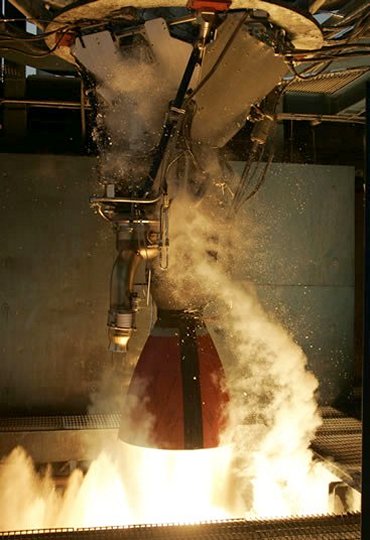
Merlin engine firing during previous Falcon-1 launch

This followed the April 30 test of the 9 Merlin engines on the Falcon 9.  The engines fired for the allocated time and the test was reported to be successful.  But there was an unexpected hold during the final minute.

Rocket Development Stress

These are intensely  complex pieces of mechanical/chemical/electronic technology.  Many countries build and launch with minimum pretesting and failure mode analyses. They fail.

Vanguard_img

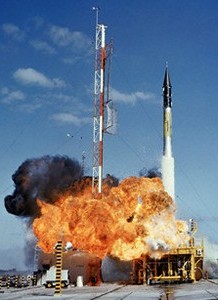
Vanguard TV-2BU 1957 launch

Americans discovered early-on how difficult it was when we built the Vanguard launcher for the International Geophysical Year (1957).  This was a wholly new system design for engines, fuel systems, and automatic control systems.  It was under development when launched out of political pressure to answer Sputnik.  The first several  ended with spectacular fire balls, though, ultimately, they did launch a Vanguard satellite (still in orbit).

In the 1950s, we had few test and analysis protocols and it seemed the best thing was: don’t  check it out, test it, blow it, fix it; try again.  Continue reading

Posted in Technology | Tagged , , , , , , | Leave a comment

Fusion Wins Reprieve

House ignores Obama, grants required fusion research budget, but it will not be over until after the elections.

Last week, we saw an astounding finish to the congressional budget assignments.  Rather than finding its coffin lid nailed closed, at this point, home-based fusion energy research seems to come out ahead in the annual sweepstakes.

David Malakoff posted in last Wednesday’s Science Insider (2012-Apr25) that, in its decisions on the 2013 budget that afternoon, the House Appropriations Committee awarded U.S. fusion energy research enough funding to continue as it has functioned to date.  This action explicitly dismissed Obama’s recommendation to kill most fusion research work. Continue reading

Posted in Technology | Tagged , , , , , , , , , | Leave a comment

Petroleum exports skyrocket while oil prices rise

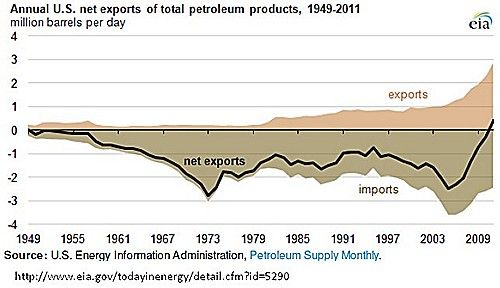
On 2012 Mar 07, The U.S. Energy Information Administration released a report on the history of U.S. liquid petroleum products (crude oil, gasoline, kerosene, …) highlighting the positive fact that exports are leading imports for the first time in 6 decades.  However, our analysis of EIA data uncovers a disconcerting trend.  Exports show a huge jump about 1980 (during the Oil Embargo),  ratcheted another jump in the late 1980’s ( lead-up to Desert Storm), and have blasted upwards during the past 7 years to reach its current unprecedented 5O+% of our crude oil production.  This is about 27% of our total liquid petroleum production.

Added after initial publish date :  The point of this post is not that we are exporting our petroleum, but that exports are growing way out of line compared to our usage, or even to our imports!  The data (below) show that similar export jumps happened 3 times in our history, when our politicians seemed to promote resource exploitation for someone’s personal gain.

This post is an update to US Petroleum Exports are Huge.  LastTechAge is presenting it because this startling chart has been taken off-line at least once in the past week, and because internet data is politically fragile.  Here is the original EIA link, also shown in Huge. Here is the PDF of the originalEIA report.

These jumps in exports happened when we as a country were under high stresses and could blame rising prices on other factors.  Although there are no names attached to the data, U.S. oil companies control our petroleum inventory. My opinion is that the export jumps represent profiteering actions on the part of those responsible. Continue reading

Posted in Natural Resources | Tagged , , , , | Leave a comment

US Petroleum Exports are Huge

On March 7, last week, the U.S. Energy Information Administration (EIA) released a short report that showed that in 2011, U.S. petroleum exports exceeded imports for the first time since 1949. That was their headline.  The data in this report are that, last year – 2011,  the U.S. had 51% of its total petroleum production for the year sold abroad.  This includes both crude oil and petroleum distillates such as gasoline and kerosene.

In this post we look at the implications shining through the time sequenced export data. Looking at these data may not sound like usual fun, but this report is not fun at all though  not for the usual data-wonk reasons

IEAreport_img

This graph shows the main data set ( directly from the EIA report). The units are Millions of barrels per day (M bpd).   U.S. demand has always been greater than production since at least the early 1930’s (ref: Footprints2) and the U.S. had to import oil to make up the difference.  It is interesting that we exported Continue reading

Posted in Natural Resources | Tagged , , , , , , | Leave a comment

Keystone XL Is About Exports

Is the Keystone XL push to the Texas coast for American energy or for export?

The U.S. EIA released a new graph that is an attention-getter. In 2011, petroleum exports exceeded imports. This was the first time for this in 6 decades. What is a lede like this doing in a Keystone XL post?  Ans: These data undermine a new attack on protestors to the XL upgrade.

The attack is a response to Pres Obama’s refusal to authorize the XL upgrade.  The argument behind it is that TransCanada Ltd. is America’s friend and truly wants the oil to reach U.S. consumers. Those who do not accept this fact are traitors against America, or maybe mad. The protest argument is that TransCanada wants to quick-ship its tar-sands oil to the Gulf refineries explicitly for access to the oil tankers that deliver the product to off-shore buyers. A lot of people have argued this, including our post here.  Our point: XL will damage the American continent and not serve to help our energy security one bit.

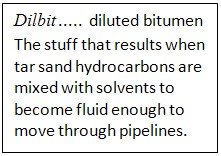
Dilbit_txtThe Keystone line ended at Cushing Oklahoma when it was completed, way back in February 2011.  Cushing seems incapable of handling the stuff when it arrives, oil just glutting about, the stuff puddling all around the landscape.  Good American patriots (the Canadian corporate uppers) want to move the dilbit via a new modern line to where the big refineries are.  Which is at the Texas coast, just accidentally near shipping ports. Continue reading

Posted in Natural Resources | Tagged , , , , , , | Leave a comment

Footprints in the sand2 – US Oil

By the late 1930s, U.S. oil industry knew continued expansion was not possible, but lived in a state of denial.

Records of petroleum production are like signposts on the roadway, pointers for future directions for life quality – indicators of what we ought to do for the future of our children.

In our previous Footprint post, we showed data signatures that our American society began the process of changing itself about 30 years ago. These data are like the fossilized footprints from long ago; they indicate that things happened, point the direction, but do not answer the who, why or where of those events.

We look at 3 periods.

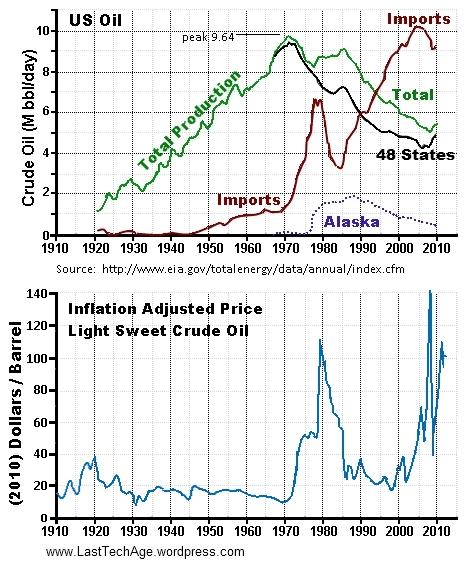
  • 1970-today (production maximum (9.6 M bpd) to current production  (5.5 M bpd).  We experienced embargoes and forcefully opened Alaskan oil fields to reduce outside impact. This worked until the North Shore fields, themselves, peaked about 1990.
  • 1880-1928 The increase of production was proportional to the amount being produced (growth as percentage of current value).  This exponential growth pattern is typical of something that starts up with no external forcing.
  • 1932-1968  Production could not return to its previous free expansion, but increased at a more-or-less steady 190 thousand bpd/year for the time 1932 to 1968, or even 1970.

Implications Of The Peak

USOil_gph

Fig 1: Oil production, import and price

Fig 1 shows the history of US oil production for the 48 states and the Alaskan North Slope fields around Prudhoe Bay.  This is similar to graphs in previous posts, but import volumes and crude oil prices are included.

In November of 1970, US crude oil production reached its all time peak of 9.6 M bpd.

This graph is a summary of recent American history.  Imports volume and crude prices jumped when Saudi Arabia embargoed oil (during the war in the mid east) and when Iranian extremists rampaged.

Look at the import curve: The 1970s’ embargo spike was not part of expected normal events. Project the non-embargo part of the curve across the spike in your mind’s eye: the trend has a smooth, inevitable increase. Prices display the same rise.  Our time of ever-increasing  supply in oil was past; Continue reading

Posted in Natural Resources | Tagged , , | Leave a comment

American Fusion – Twilight of the Gods?

The American fusion effort needs help to defend against planned budgetary destruction.

“Bigger Contribution to ITER Erodes Domestic Fusion Program” is the headline in this week’s Science Magazine report by Adrian Cho. It refers to the 2013 budget decisions at the political level in the US.  We have discussed Science magazine before;  its section on current news is outstanding.  Maybe the best chronicle of the American decline in front-line science capabilities, both scientific exploration and technical development.

LastTechAge has discussed fusion before,  and here is my standard disclosure: I am a physicist who at one time worked in the fusion energy program at General Atomics.

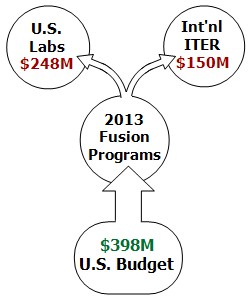
FusionBudget_imgWe are on the edge of a deep drop-off, but it may be hard to step back and see where the problem is. After all, the DOE Fusion division got 99% of its 2013 request for funds.  Stay with me, this budget stuff does get interesting.

The diagram shows what looks like a lot of money flowing into fusion programs but tiny streams into the US labs and into ITER.  This is because the amount to flow into both are insufficient for either one;  we are threatened with the death of both ventures.

ITER_dgm

ITER diagram. 2 people, circled

The problem is that, to stay in play, we must pay larger ‘dues’ to the international ITER ignition machine being built in France.  The ITER support fund rose by 43% to $150M while support for American fusion labs is decreased “a little” to $248M in 2013 dollars.

Two problems with the budget

  • ITER costs have gone up and our actual bill in 2013 or 14 will be close to $300M (a 2× shortfall). We will feel push-back from the financially stressed rest of the world.  And soon.
  • The US labs were previously at the precipice edge of funding; massive reductions in capability must follow any new reduction. And quickly.

ITER (pronounced ‘eater’ in the European way) is the next necessary step in fusion research. The ITER design was proposed in late 1988, but was not seriously considered until the 2000s.  It is very expensive, but almost certainly will produce an ignited plasma.   Without ITER, there is really no reason to continue with fusion research.

ITER is very similar to the INTOR proposal of the 1980s which was an outgrowth of many earlier proposals. This step is needed and will almost certainly work as planned.  Why were neither INTOR nor ITER  not funded at that time?  Tough question – both then and now. Continue reading

Posted in Technology | Tagged , , , , , , , , | 3 Comments

Records of Inequality – Footprints in the sand 1

George Orwell missed by 4 years.

Massive social changes have happened over the last 30 years. Our hugely powerful American society strongly differs from what it was then. This is the first of a series that will look at some of the trends that emerge from recorded data. We can see some things happened, and when, but will never discover why and who this way. Trendlines on the page are like a mass of footprints in sand, we cannot know what was going on, but they are there.  Basic trends lead to the beginning of understanding; let us review records before all indentation in the sands of time are smoothed away by the waves of new events.

In this Footprints series, we will not attempt will be made to link to a possible whys or hows.  Quick answers would probably be conspiracy-theory simplistic, anyway.

Significant Changes Happened in the last 30 years.

The five graphs in Fig. 1 all have the same time line. For example, 1980 is at the same location along each chart.  Scan vertically to see how things change in relation to each other. To see the correlated behavior better, double click the image and display the entire file on the screen.  Click on the underlined figure name in the paragraph for the graph image. That is, click  1C to bring up the single graph shown as (C) in Figure 1.

5_Timelines_gph

Fig1:  5 Indicators of class inequality during the previous 100 years.

Fig 1A Peak oil

1A  is the US oil production history.  The heavy green “Total” line shows the Total annual oil production extracted in the U.S. The black line is from the lower 48 states. The difference between the two is from the Alaskan Prudhoe Bay (dotted curve). Production of crude peaked in November of 1970.

This is displayed because of the peak’s impact on how we developed afterwards; it imposes profound constraints on our options in the future.

Fig 1 B,C  Shares of Total Income

The upper earners suddenly started taking an ever-larger fraction of the money flow starting about 1980.  This graph follows Dr. Emmanuel Saez’ lead in showing fractions of the total earned each year, rather than the dollar amount, because the total dollar amount changes and because inflation rates are highly variable.

1B shows the post ’80 rising earning share transferred to the 10% of all households that earn the most.

1C shows the post ’80 falling share that goes to the lowest earning 1/5th of workers. The earning shares of the other 70% of households lie between the trendlines for the top 10% and the bottom 20%.

Fig 1D Tax Rates of the Classes

1D shows how our class groups fared in their official tax rate. The powerful Ultras got the largest drop in taxes (after ’80, of course). They also multiplied their share of the total US earnings by 5. Continue reading

Posted in Economics | Tagged , , , , , | Leave a comment

Tom Friedman and The End of US Manufacturing

Outsourcing destroys our well of creativity, it is terminating American excellence, Mr. Friedman.

Thomas Friedman’s column Made In The World, in the 2012 Jan 29 issue New York Times is the ideological bible for modern business.   He had better be careful or his columns will supplant Ayn Rand as the prophet of choice for the very rich.  Disclosure: LastTechAge’s posts on American Inequality (such as Elite Deserve What They Get) oppose nearly every one of his statements.

This is a report on the current state of an ongoing epiphany described in Friedman’s 1999 book The Lexus and the Olive Tree and his 2005 book The World Is Flat.  Globalization has changed core economic concepts and we all will come out ahead. So what if we send American factories to China, India and South-East Asia?  This lifts the workers there and we all benefit as a thriving world-wide society. This is true because it fits Tom’s utopian vision of a wonderful world; also, he has the word of many of big company CEOs for it. We merely need to send our manufacturing centers abroad and train our entire workforce in advanced programming, nano-technology engineering, or something.  No, no, sorry! That last was from Bill Clinton.

Stay inside Friedman’s closed loop, and it all makes sense.  If we all just did reasonable things, if our top CEOs did what was best for their companies and the people who depend on them, there would indeed be a beautiful world a’ borning;  we would build a golden utopian world of peace and joy.  This is the structure of a classic ideology-based scheme –  IF everybody did right THEN all would work well. Continue reading

Posted in Economics | Tagged , , , , , , , | Leave a comment

Has NIF been retasked?

Have U.S. laser fusion goals been delayed by the atomic weapons establishment?

In the news this week  NIF (National Ignition Facility) at  Lawrence Livermore National Laboratory (LLNL) has had its fusion energy test plans slowed an unknown number of months, apparently by nuclear weapons related studies with higher precedence.  LLNL  is the California-based government laboratory tasked with safeguarding our nuclear weapons inventory, although it has a history of broadening itself into other activities.

The apparent retasking of NIF activities was publicized by an article (Laser Fusion Alters Goals, Fueling Concern Over Strategy) by Daniel Clery in the 2012-Jan09 issue of Science Magazine. (Science is a professional journal for active researchers with the best weekly summaries of scientific news and politics to be found; the content is not free but is always meaningful.)

click for list of our ICF/IFE fusion posts

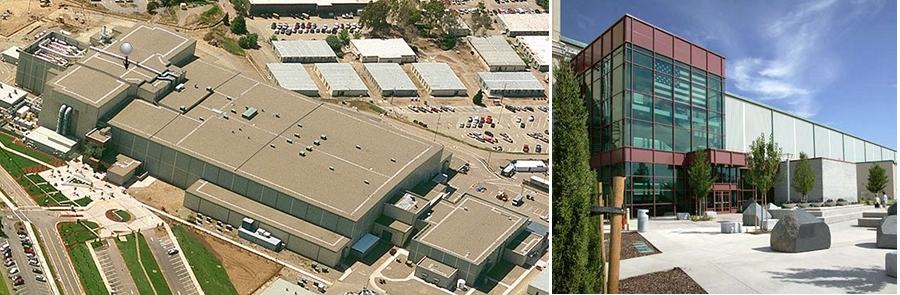
Fig 1 shows the NIF facility at LLNL.  The left image is a aerial picture of the building.  The 10 m  (30 ft) diameter test chamber is represented by the scaled silver ball added to the image (upper left on building).  The chamber is inside and below the ball.  The rest of the building houses the lasers and beamlines.  The  image on the right is the building’s entrance, also visible in the left-hand image.

NIF-facility_img

Fig 1. (L) NIF Bldg. A target chamber sized sphere is sketched, top left.  (R) NIF Entrance also seen in (L)

NIFlaserputse_img

Fig 2. View from inside NIF chamber of Laser beams converging on target

Generation of fusion energy using lasers is the goal of ICF (inertial confinement fusion) research in Japan, Europe, China and on around the world.  The initial task for all is to demonstrate nuclear fusion at a break-even level, then to develop optimal strategies that could lead to power generation.

Fig. 2 shows NIF in operation, but probably in a set up mode.  When running fusion power, the laser beams would not be visible because the 30 ft chamber would be under vacuum.  Note our banner picture.  On the right is a target shot in the KMS Fusion chamber dating from the mid 1980s.  This NIF shot is the very modern update to target shots going back to the 1970s, when KMS Fusion set the then-record of fusion events in a target implosion.

Continue reading

Posted in Technology | Tagged , , , , , , , | Leave a comment

Keystone XL and the Quality Ethic

The year-old Keystone pipe line has intrinsic quality issues.  Cancel the  XL upgrade!

Last last Saturday, the Lincoln Nebraska online news journal, the JournalStar, published an article by an engineering whistle blower, Mike Klink.  His point:  The XL initiative is not about jobs (way over inflated) nor U.S. energy security (XL diverts to the Gulf coast shipping docks), it is about lots of new money for the upper levels of the well compensated.  I have called these guys the ultras.

The article’s title is “Mike Klink: Keystone XL pipeline not safe.”   It is one thing to write papers based on analysis, as I we have done.  It is a completely different level of believability (and personal danger)  for the same basic points to be made by an eye witness observer.  This guy worked for a principal contractor of the initial Keystone line, Bechtel, who apparently cut all the corners in the book, and banked nice round numbers.  The original Keystone has had a bad first year of operation history of leaks, breakdowns and shoddy infrastructure crises. It is a project you might expect from a Chinese manufacturing enterprise.  Do the job as cheaply and as quickly as possible, then make it happen cheaper yet.
Continue reading

Posted in Natural Resources | Tagged , , , , | Leave a comment

Paul Wheaton, CFLs and Huh?

CFL superiority is tested.  Here is the report

I ran across this blog post by Paul Wheaton, a Wyoming permaculturist (his main thrust is about agriculture that is fundamentally sustainable and permanent), decided to get financed and do some tests on various claims about compact fluorescent lights. Here is the entry to his home page.  His title summarizes his findings– CFL Fluorescent Light Bulbs: More Hype Than Value.

click for a list our posts on illumination technology

If you read LastTechAge much, you know this is my favorite rocking horse to jump on and go charging after windmills. We have a series of posts, summarized here, discussing the fluorescent/incandescent issues from a physics viewpoint.  My view:  fluorescent lights win hands down in a factory or business lighting environment.  But for home use, nope.

The internet is full of postings on CFLs, yeah and nay.  Wheaton’s is one of the better ones.  He has effective data, explains things well, summarizes others’ work as well as his own testing, and also, shows some great videos making the various points.  The last one (time to full illumination) is my personal favorite – well worth the trouble of clicking on the link, scrolling to the bottom, and watching.   Thanks, Paul, for taking the trouble to do this!  Again, his blog post is “CFL Fluorescent Light Bulbs: More Hype Than Value.”

……………………………….

Charles J. Armentrout, Ann Arbor
2012 Jan 02
This is listed under   Technology   …thread Technology >  Fluorescents
Have a comment? Click on the title of this post, go to bottom, let us know.
Related posts: Click the INDEXbutton under the Banner picture

Posted in Technology | Tagged , , | Leave a comment

The Mercury Connection – Fluorescent vs. Incandescent

The EPA’s power plant emission ruling makes fluorescents much worse mercury polluters than incandescents.

This year the fluorescent light lobby has publicizing estimates that show that incandescent lights cause more mercury emission than fluorescents because they use more power. This is because coal and oil burning power plants currently emit 50-60 tons/year of mercury. Estimates vary according to which government source is used.

click for our discussions on environmental pollution

Those calculations are obsolete.  The EPA’s ruling last week (see our post) on pollutant emission by all plants will force the remaining large coal/oil burning power plants to install remediation technologies.  Once complete (they have 4 years), the mercury emission from all power plant sources will be 1/10 of what they are today (December 2011).  Not just mercury poisoning, but asthma-causing particulates, or acid rain generating SO2; a whole host of bad issues will be lifted from our countryside.

Implications For Fluorescent Lighting (FL)

HgSources_tbl

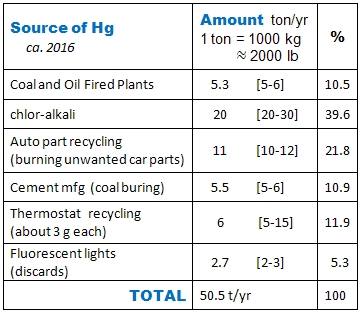
Fig 1  Sources of atmospheric mercury 2016

Fig. 1 shows the estimated mercury releases in 2016. We estimated the fluorescent light industry will cause a final steady state emission of 2 to 3 tons of mercury compounds per year.   The total power industry will emit no more than 6 tons/year.  Discarded fluorescents will release half of what the coal burners do.  They are not a leading source of mercury emission, but are significant

Is there a trend?  From the 1950s onwards the automotive industry deliberately undercut rail transportation, paying cities to pull up trolly tracks by cut-rate gasoline buses, and heavily promoting 18 wheeled trucks over efficient freight trains for cross country commodity transport. When made in earlier years, this sounded like commie talk.  But it continues: why were rugged tape cassettes made obsolete by easily damaged CDs of the same capacity? Why have rugged glass food containers been replaced by multilayer plastic bottles where contents can go bad after 20 to 30 months? (Food can go bad in glass jars, too, but mostly by incomplete sterilization or poor sealing.)  Why ban mercury thermometers (about ¾ ton/yr) for brand new IR thermometers that do not work without batteries? You probably have examples from your own experience.

Who stands to gain when the population is forced to trash reliably functioning goods and replace them by new items?  Not so original advice:  follow the money.  For example, who gains by selling everyone entirely new lighting systems?  I share a nightmare – we shift to the new lights and they really do last “10 or 20” times the current generation of incandescent bulbs. Sales in a  steady economy must fall by this factor, and manufactures must raise per unit prices by this amount, to stay in business. A $2.50 CFL must rise to $25 were today’s sales volume to drop by 10. No problem, if you are in the elite income bracket (annual income over $250,000).  If you make median income or less ($50,000) you may not be able to replace a burned out bulb when its price is so high.  Indoor lighting could become a rich man’s privilege (we might return to lighting-as-conspicuous-consumption as in the 1890s when Thorstein Veblen was working on his Theory of The Leisure Class).

Not all regulations fall under the “follow the money” rule.  Seat belt laws did not require junking all current automobiles but saved many lives.  Unleaded gas laws, the same thing.  The initial effect was an increase in price of most of the regulated goods, but that effect went away and huge benefits came about.  FLs do not fall in this category.

Don’t believe all the hype around fluorescent lighting  <as discussed elsewhere>.

  • Higher energy efficiency.   If you leave the light on 10 hours a day, this is absolutely right. No one would leave an incandescent light on like that.  FLs vastly dominate in businesses.  Be sure to leave all your lights on all the time, the same way they do.
  • Longer useful lifetime.  Not by much, if you burn them out by continuously switching FL lamps on and off.   Second: not if they made in countries lacking a quality ethic, willing to take shortcuts and ship defective or dangerous items.  Third: brightness fades with months of use.  Even if it does last, after a couple years a bulb will be about half as bright as when new.
  • Lower pollution.  The point of this post.  FL discards will pollute mercury at about half the rate of power plants.  The heavy metals in the phosphor layer are discussed here.
  • Cheaper.  FLs left on all day can be more expensive when compared to an incandescent that is on only when needed. Already discussed: market price increases due to drop in purchases.

I think that we are moving to another level of dependence through off-shore lighting with even fewer manufacturing jobs.

……………………………….

Charles J. Armentrout, Ann Arbor
2011 Dec 28
Listed under   Natural Resources    …thread   Natural Resources >  Pollution
Find related posts on the
INDEX page, or click [Categories], right.

Posted in Natural Resources | Tagged , , , , , , | 1 Comment

EPA Limits Mercury in Environment – Is it enough?

Are the new EPA power plant rules strong enough? Will they work as popularized?

The Environmental Protection Agency just announced (2011 Dec 21) that it has issued its CSAPR  (cross state air pollution regulations) will begin to enforce emission standards on coal and oil fired power plants. This has been in process for at least 20 years.  The final link in the protection chain was Wednesday’s release of MATS (mercury and air toxics standards).  Actually, this is a huge step that could/should have happened 3 or 4 decades ago; it will protect our children as they grew from fetal infants to adult.  Quick answers to questions at the top:  The rules are important for cleaning our breathable atmosphere.  Given the chance, they will work but will not reduce all mercury etc. to zero.

Description

Emission compounds.  Even if it had no effect on mercury releases (source of 50% of atmospheric mercury), it will eliminate 90% or more of the current emission from coal and oil  EGUs  (electric generating units), including arsenic (current contribution: 62%),  acid gases (77%)  SO2 (60%)  and a host of smaller contributors, including breathable fine particles.  Our EGUs are the dominant contributors of atmospheric pollutants.

Timing: These rules have a 4 year implementation time built in. This is hugely more than needed, the power industry has known about this and fought against it for 2o years, at least. The EPA says that we have the 40% refuseniks who are now obligated to do the upgrades.  There is a lot of money here, many of our ultras are top people in the power industry, so expect a lot of whining in the near future. The resistance to this was pretty strong, check Mercury, Power Plants, poison.  I suspect this will end up like unleaded gas and seat belts – huge industry resistance, enforced federal requirements, then dancing pride about their forward leadership in the issue.   Whatever.  We should see the start of clean air in 2015.

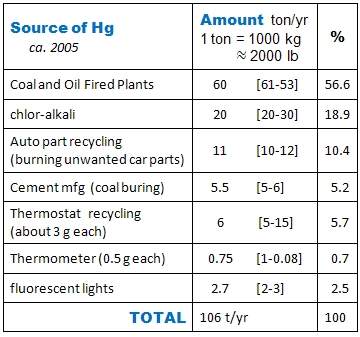
Hg2005_tbl

Fig1:  Sources of atmospheric mercury 2005

Mercury (Hg):   A simple answer on EPA impact is made difficult by several factors – option choices for remediation , different kinds of EGUs to upgrade, all these mean the exact overall reduction is hard to state right now.  The EPA estimates an approximate 90% reduction in Hg once the new requirements are standard operating procedures. Other pollutants might be reduced by 99%.

We will use: EGU-caused Hg pollution in 2015 will be 10% of their current levels.

Fig. 1 uses our original oil-coal estimate, see Fluorescents-6 for details.  The % of total is quoted with 0.1% accuracy so the column would sum to 100%, but probable accuracy is no better than ±0.5%, and in some cases worse.
HgSources_tbl

Fig 2:  Sources of atmospheric mercury 2016

After all the startup delay, environmental Hg pollution should look like  Fig. 2.  This is a halving of the mercury going into the atmosphere then the lakes, etc.  We still have an optimistic 5 t/yr accidental emission from EGUs.

Figs 1 and 2 differ in their Coal and Oil Fired Plants row.  Fig 1 60 t/yr is from a different source than the EPA.  Fig 2 uses the EPA 53 t/yr in 2005.  You will find different values for this in different references.  Although changing from 53 to 60 changes the far right column only in the decimal place, we optimistically use 53.  The fluorescent lighting entry is from our estimate of mercury release due to people discarding, not recycling their burned out lights.  Thermometers is dropped here, because it will have been 15 years since they were totally banned and the entry into the waste stream will have become trivial.

Implications

By 2016 the power plants’ contributions to Hg emission will have decreased to 10.5% of the total. This is nearly 5× drop and all due to the rules.  This is not zero and is about the same as our highly regulated cement plants.

This is really positive, but the spin could sound shocking. Scientists tell us that we have solved our problems, but we regulated and controlled and only dropped environmental mercury by half.  Personally, I felt a huge relief when this was announced.  It has taken only several hundred years to accomplish:  mad as a hatter is a very old phrase referring to the brain damage caused to people using mercurized sewing thread. It was essential to reduce emissions from power generators, our next task (look at Fig 2) will be to reduce the release by the chlorine users (via product wastes) and the auto-part recyclers (via incinerator exhaust).

click for our discussions on environmental pollution

This does not represent government gone bad, as per Rand Paul, but is the very reason for government’s existence. People group together for common defense. For example, local warlords would ravage and enslave regions; effective cooperation makes the countryside safe from thugs. We need cooperative joint protection of a responsive government. We are surrounded by special interest destroyers who work to eliminate what holds us together as a people.  Use a similar analogy toward producers of environmental toxics that freely damage the next generations.  (Plural because babies are continuously born yet another generation in +20 years.)

There are many reasons to applaud EPA’s courage and hope Obama does not compromise this into oblivion.  This is a start, now let’s eliminate the next 1/2 of our mercury emissions.

……………………………….

Charles J. Armentrout, Ann Arbor
2011 Dec 23
Listed under    Natural Resources    …thread   Natural Resources >  Pollution
Have a comment? Click on the title of this post, go to bottom, let us know.
Related posts: Click the INDEX button under the Banner picture
Posted in Natural Resources | Tagged , , , | Leave a comment