Elites or Ultras – Income Inequality 5

The upper 1% incomes are blamed for our economic troubles, but the upper 0.01% are probably the ones at fault

This was to be an update to the previous post, Overstated Gains.  But a new report on The American Prospect’s Balance Sheet brought the issue to the top again.  During these last 3 decades, who is the Grinch that has taken Christmas joy (opportunity and jobs) from most of American families?

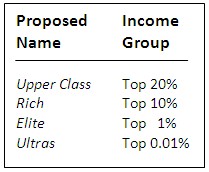
Many, including the Balance Sheet report, indicate “top 1%.”  We call these the elite American earners.  How many are in this category? There are 119 M households reporting incomes to the Census Bureau, and 1% of these form a population of 11.9 M families (11,900,000).   The elites are a group of this size who take in $1.5M or more each year.  “Millionaires” when I was a kid. This is only 30 times the median income, sort of high, but would you call this excessive?

The Balance Sheet quotes JP Morgan Chase CEO Jamie Dimon, and John A. Allison IV, former CEO of BB&T Corp, who have founded a poor-rich-guy’s defense council, the Job Creators Alliance.  This group will come out tootling horns for the job creating best of the brightest; the perfect blast of Randian Objectivist triumph.  Bernie Marcus discussed the objectors to the upper-ups – “Who gives a crap about some imbecile?” in reference to comments from Occupy leaders.  Alliance co-founder Tom Golisano  said that if he heard one more politician bad-mouthing the top rich “I’m going to vomit.”  The gentlemen appear not so much as Ayn Rand’s John Galt, but as her sociopathic Howard Roark (read end of Gains)

The co-founders of the new Job Creators Alliance are not just elite millionaires, they are billionaires, people who belong to the top 0.01% of the population; our ultras.  Refer to our Zero Sum Game:  Emmanual Saez’ group reported that income for an ultra household started at $11 M in 2008 with mean income at $17M.  The Balance Sheet says Mr Dimon, for example, makes $23M every year.  It is not just the income that makes them ultra, their billion dollar net worth counts, too.

Who Has The Dominant Wealth?

EarningShare_gph

Reported earnings of each upper class are dominated by the next higher class

In Overstated Gains, we examined whether all the elites benefited equally.  The graph (right) summarizes the development done there.  Each earning class (20%, 10%, 5% etc) has a large share of the total US income.  Each is summed from its starting income ($100k for the top 20%) right up to the final highest reported income.  But the next higher class actually accounts for 1/2 to 2/3 of the original’s reported income.

The 20% class earns 1/2 of the total US income, and this sounds as though everyone earning $100k and above added equally.  Actually, the top 10% (starting at $138k) makes 2/3 of the total in the 20% group.  In fact, the mean income for the upper 20%  lies deep in the 10% territory.  The top-most classes are taking excess money from the pool, but this needs better explanation. Continue reading

Posted in Economics | Leave a comment

Overstated gains? Income Inequality-4

The upper 1% incomes are blamed for our economic troubles, but the upper 0.01% are probably to blame

Income inequality is a dangerous fact in American life, but there is a certain feel to the available data that make it unclear which of our upper class groups is/are responsible.  This is our first follow-on to our focus post, Zero Sum Games.

Each income grouping reported by the Census Bureau for year 2010 includes all higher earning classes.  So each group gets a ratings boost from their betters, without benefiting from the actual income.  This discussion might get a little wonky.

Three clerks (incomes $30k, $31k, and $33k)  enter an elevator on the 2nd floor and ride together to the 10th.  Their mean income is $31.3k (sum divided by number of people), their median income is $31k (half those clerks earn median or less, half earn median or more).  At the 5th floor the CEO (annual income of $17M) joins them, chats for a few seconds, and gets off at the 8th floor.   During that time, the median was $33,000 while their mean income was $4.3M .  Tell those 3 clerks they were lucky for that average $4.3 Million each – and prepare for backtalk.  Similar complaints from our top 1/5 when blamed for skimming the income pool at the expense of all lower levels.

Jump to Overstated Gains?, Yes they are overstated , Discussion

————————–
Overstated Gains? 
Proposition: Growth in the share of income is mostly overstated, not as unfair as it sounds.

Household-Income_gph

Figure 1:  Number of US Households vs income amount (Census Bureau, 2011 Sept)

Figure 1, the income histogram (income per household for all the earning households) in the U.S.  From Zero Sum Games.  Data from the Census Bureau (2011 Sep), with histogram data here, and breakdowns here.

The vertical (dotted green) lines divide households into 5  equal-sized, successively more prosperous groups (quintiles).

GroupIncome_tbl

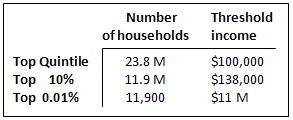
Figure 2: Group size and threshold income. M is millions

In addition, we see the top 10%, 5% and the uppermost 2% of population.

The argument:   Since each group adds the incomes at group threshold and higher, the huge gains of the top 0.01% ultras boost all averages.  Maybe ultras are the true economic predators?

IncomeShares_txt

Figure 3: Changes during the past 30 years over the preceding stable years (ref: Zero Sum)

In Zero Sum, we saw that there was a baseline period (during the 30 year period starting right after WW-II) where the fractional share of total annual household income was pretty constant for every class. (Census has data only from 1967.)

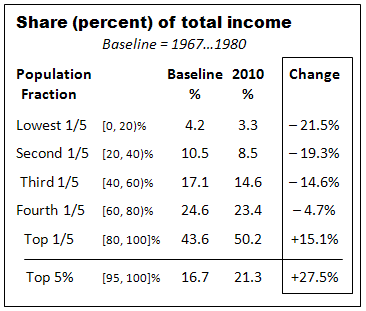
Over the past 30 years (after 1981), the lower 4/5·ths of earning households lost share of the total earned income “bigtime.”

The top 1/5 registered postive growth – taking income share from the lower classes.  The biggest jump went to the uppermost 0.01% (a multiplier of 5), our ultras.

Is “Overstated” Justified? The lowest salary a household can earn and still be classed as top 1/5th is the dotted line at $100,000 in Fig 1.  An earner of the 20%’s mean income of $170,000 would be classified as belonging in the smaller top 10%, whose minimum income is $138,000.   There is definitely some upper income spill-down.

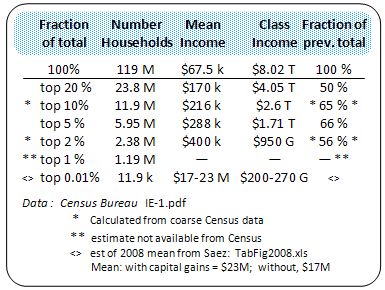
Figure 4:  The top income levels have significant overlap

————————–
Yes, the gains are overstated for most people in the top quintile.

Fig 1 shows that most of the people in the top 20% are squeezed into the left, low-dollar side of their bracket. The summed earnings, though, are pushed to the right high-dollar side.  Using Fig. 4:

Top 20% – half of total U.S. income  (= 4.05/8.02)
Top 10% – 2/3 of top 20% income (= 2.6/4.05)
Top  5%  – 2/3 of top 10% income  …   also 42% of the top 20% income
Top  2%  – 3/5 of top 5% income.
Top 0.01%   –   1/4   of the top 2% income

The Sept 2011 release of 2010 data from the Census Bureau included mean and median incomes for the 5 quintile segments and also the earning households that get the top 5% incomes.  One can get reasonable estimates from the statistical data for the top 10% and the top 2%.  I was not able to find any 2010 data on the very uppers, the top 1% and higher.  I used data from Emmanual Saez‘ team for the ultra top 0.01%, even though they were for 2008 and 2010 income might be somewhat below this.  The Saez data are shown as a range of values.

The data are pretty clear:  Substantial parts of reported earnings are not made by the everyone in that group, but by the much smaller subset, with much greater incomes.

Although the data are absent, I would be really surprised if the ultras did not account for half of any reported take attributed to the top 1%.

————————–
Discussion.

So, the conversation turns to “who has been playing dog-in-the-manger?” The lowest in the top 20%s do not feel like financial carnivores, although they are the ones who decide salaries for the bottom 4/5ths

They have financial worries, but about long range success, not day-to-day survival.  Each successive level in the upper 20% is preyed upon by the predators above them.

Yes, each of the upper levels did feel a net increase in income fraction but the huge winners in our 30 year derby are those ultras with their tip top earnings.

The ultras have the economic power to destroy any threat, and purchase any outcome they want.  These guys invert the  Libertarian and/or Randian mythos of the best and brightest job creator.  The classically iconic John Galt is increasingly inappropriate when applied to those with ever-higher incomes; the moocher/looter predator image for the ultras  is the closest to Ayn Rand eschatology we get. (Even so, her Fountainhead’s Howard Roark did win high marks for blowing up his building full of unworthy moochers.  A 1990s kind of joke → Roark had a really wretched personality, but he did kill off hundreds of commoners.)

Gretchen Morgenson (NYT, 2011 Dec 18) has a  report  on the failed Washington Mutual mess.  CEO Kerry Killinger,  President Stephen Rotella, and Home Loans President David Schneider destroyed their company, burned up other people’s investments, and wound up really, really well off.  Similarly, I always thought it wonderful that Ken Ley died so conveniently before his conviction was pronounced, and his loot stayed in the family.  Thoughtful guy, that Ken.

click for our discussions on economic inequality

Economic gains over the last 3 decades has been a progressive thing, the higher you are, the more you get, at the expenses of those in Economy’s basement.

………………………………

Charles J. Armentrout, Ann Arbor
2011 Dec 11
Listed under    Economics     …thread   Economics >  Inequality
Have a comment? Click on the title of this post, go to bottom, let us know.
Related posts: Click the INDEX button under the Banner picture

Posted in Economics | Tagged , , , , | Leave a comment

Elite Deserve What They Get – Income Inequality 3

Some say income inequality in the U.S. is neither unjust nor dangerous, but the purest form of American fairness.  Our elite deserve all they get.  This is a follow-on post to our main discussion in Zero Sum Games.

Our Deserving Ultras.
Proposition — The elite top earners are the best and brightest, the job generation class.  Anyone can reach this level because of our renowned upwards mobility.

Such self serving comments are usually made in an unattributable, private form.  The Diane Rehm  show on NPR  (2011 Oct 28) featured David Corn of Mother Jones Magazine, Jeanne Cummings of the Bloomberg News, and Byron York of the The Washington Examiner.  York either works or has worked for The National Review, The Wall St Journal, and The American Spectator.  He is associated with a lot of libertarian thinking, and this ol’ boy came through like a champ.  Listen to the audio broadcast and read the transcript while you listen.   * It is more useful if you do both.

Jump to (transcript) 10:16:55 or (audio) about 17:28. The discussion is about Tea Party activists pushing the Republican agenda about.  Here is the quote.  York: “The Republicans believe that that top 1 percent has a disproportionate amount of talent, smarts and ambition, and more so than the lower 20 percent.”  then “… they also believe, Republicans do, that they [the top 1%] are the job-creating class.”    Emphasis, mine.

IncomeShares_txt

Figure 1: Changes during the past 30 years over the preceding 30 stable years

I mostly agree even; well, sort of.  The top 1% have the talent to do whatever is needed to get where they are, the smarts to keep what they have, and ambition to obtain the insider information needed for success.   These are the guys who are too rich to fail, with the financial influence needed to stay on top.

Figure 1 show trends in class share of the total income (Census Bureau data) from our Zero Sum post.  The top 20%, 1/5 of the population, now account for more than half of the total U.S. income. This share has grown 15% over the past 30 years, compared to the baseline stable years.  The top 5% increased their share by well over a quarter during the same period.  If the data were available, Byron York’s top 1% would be seen to have done better yet.  The top-most 0.01% ultras (see the Zero Sum post) increased their cut by +400%.  The negative values show where all those increases came from.

Job creators?   Our elites (and their ultra betters), strip our factories, send them across-border, and create profits for themselves. They create jobs – not here, of course, but in China, India, Mexico, … elsewhere. Compare: David Packard and Bill Hewett were strongly innovative engineers, who retained their technical vision to lead their company to continual successes.  Both were gone by the mid 1980s, and HP was taken over by the managerial class with no understanding of their technology underpinnings.  Most of America’s legacy technology companies have the same sort of history.  Recent example: Apple succeeded with Steve Jobs, floundered when he was gone.

Challenge:  stand on a corner in a large city’s busy shopping district, and take off everything missing a [Made in USA] tag.  Nowadays, you would finish up stark naked;  30 years ago, you would have remained quite modest;  60 years ago, you would have felt silly standing about with nothing to do.   So where are all those jobs the high quality elites generated?  Four of our five quintiles have lost income share and economic opportunity in a big way.  I would suggest doing the same test with the steel parts of your car, but I hate seeing cars drive about naked.

Paul Krugman’s  column in the 2011 Dec 09 New York Times discussed the elite job creators.  He ended up comparing our top income earners with Gekkos, not the lizard type (biology), but the Gordon type (movie). Gordon is the guy who first said “Greed is good!”  Many think Ayn Rand coined that, or maybe at least the Libertarians.  You might want to actually read the column. He discusses Mit Romney, who makes himself out to be one of the great Job Creators …  hhmm.

A couple decades ago, I first made contact with one of these job creators who walked about and created in public.  The company I joined had been purchased by a poor rich guy.  He got into power, saw a huge pot of goodies tied into the employee pension fund and converted it to an Employee Stock Ownership Plan (ESOP).  He proceeded to anger his principal contract, the company lost all viability and disappeared.  His favorite complaint was – why can’t all those bright employees give him at least one home-run?  Several first for me.  First time I heard the word “bright” used as a pejorative and “home-run” as a technical business term. But not the last time for either, though.  The employees were laid off, pension funds lost, and the country lost a player in fusion energy development.  Are financial elites the best and brightest, the super job creators?  no

Upward mobility?   As we turn off the lights in our creative manufacturing sector (not our “assembly” plants but the places where components are actually made), we shut down the paths for creative work.  You cannot generate the next generation stuff if you cannot work with forward products as they are changed from raw material into salable goods. Thirty years ago, upward mobility was the realizable American dream.  Modern spin “We will train the highest level of innovators in classrooms” is to pacify, to make the real social solidification palatable. This is not a vision for success.

End notes
We might get what we deserve for drinking elitist Kool-Aide.  Since the ’70s we have confused the people who make the most with those who are the most creative.  We have been paying for this, we still are, and will probably continue to do so.  The process under discussion is summarized in our page, American Income Pump.

click for our discussions on economic inequality

There are several ways this story could end.  1: It might continue on as a straightforward projection of what has been happening – more of the same ol’ same ol.’  Probably not, though. Chaotic social systems do not remain static.   2: A charismatic leader might rise above self serving politics. We tried this (2008), were fooled.  3: We might go through a chaotic branch jump.  Problem … chaotic changes cannot be predicted (by definition).  The elite might complete its metamorphosis into hereditary aristocracy – as gray darkness descends on our newly feudal society; or, the elite may well get its deservings as did the social elites in France(1790s),  Cuba (1950s), etc.  The last time we were so close to a branch point, Franklin Roosevelt installed measures that disarmed the then-disruptive communist rhetoric. In the end, it’s our choice.

Update: 2011 Dec 11  The same day the above appeared, Henry Blodgett posted  Finally, A Rich American Destroys The Fiction That Rich People Create The Jobs  on Business Insider.   This is a really good discussion of points reinforced here, without the gloom that comes from my sense of dark shadows descending over our country during my working lifetime.

……………………………….

Charles J. Armentrout, Ann Arbor
2011 Dec 10
Have a comment? Click the title of the post, go to the bottom and let us know
Listed under   Economics     …thread  Economics >  Inequality
Related posts: Click the INDEX tab under the Banner picture, or click [Categories], right

Posted in Economics | Tagged , , , , , | Leave a comment

The Poor Rich – Income Inequality 2

Some folks say that this income inequality thing has been blown all out of proportion.  The upper groups aren’t doing so well, actually, because life is more challenging and expensive at that level.  This is a follow-on post to our main discussion in Zero Sum Games.

Poor Little Rich Guys.
It’s really hard being one of the elite top earners, so don’t call them “rich.”

In late 2010, Liz Weston wrote an MSN report  explaining why no one should think $250,000 was a rich income.  Comments like this are made casually by the right wing on television and talk radio, easy to hear,  sometimes hard to find in quotable form.   The point seems to be:   Life is harder when you are floating on the surface of the pond, than when you are underwater at the bottom.

A (2011 Apr) Free Money Finance (FMF)  discussion took on this self justification for those earning over $250k (the starting income for those in the top 2% of all incomes in the U.S.).  Census Bureau data (2011 Sep) and showed that these are elite people, earning 5 times more than the median U.S. income.   Recall, median is the dividing line for household earners, half of all households earn more, half less.

The FMF point was that these guys have developed insatiable hungers for stuff.  They look upwards toward the top 1%-ers and ‘need’ what they see.  The poor elitists in 2% level get into huge mortgages, heavy debt, etc., and are really unhappy.

FMF said the elite need to live more frugally. FMF got it right, in our opinion.  Suppose they earned their $250k but lived within a budget set to the median $49,500/yr salary.  They would have zero financial problems and could still swagger about, living better than 50% of our population.  Tune down expectation – why vacation houses, yachts, Mercedes and Lexuses?  For that matter, why any new cars every year?

Big earners get into bigger hungers, go into huge debt.  Their troubles make them big whiners, and mimic Ayn Rand’s moocher class.  Not pretty, guys.

Elite incomes do not automatically mean  happiness, just enhanced purchase power.  Wealth brings great expectations, temptations, tensions, debt, stress, suspicion, anger, sometimes enhanced suicide rates.  No joy either promised or delivered, just cash.

click for our discussions on economic inequality

According to the  apologists, critical comments like these are just evidence of class warfare by the lower level gripers.  In these weeks remaining before the 2011 Christmas holiday, we will look at which grinch it was that really has been stealing everyone’s Christmas.

Update: 2011 Dec 11 Market Place (American Public Media) interviewed a formerly high income family who lost their money.  The 6 year old said “We were not rich. We just had money.”  The 6 year old was right. Wealth is more than current earning levels.  (Link not available at this time.)

We have summarized the income inequality points in our page American Income Pump.

……………………………….

Charles J. Armentrout, Ann Arbor
2011 Dec 9
Have a comment? Click on the title of this post, go to bottom, let us know.
Listed under   Economics   …thread  Economics >  Inequality
Related posts: Click the INDEX button under the Banner picture

Posted in Economics | Tagged , , | Leave a comment

Social Inequality – Zero Sum Games

Income shifts out of lower incomes into the upper levels, in a kind of zero sum game

There has been an unusual stir in the recent news about the increase of income inequality in the United States. Wealthy households are better off than ever, while the majority in the population (more then 50% of our families) are seeing their income fall and their jobs disappear.

The flurry of interest is from a confluence of congressional turmoil over Obama’s American Jobs Act, the Congressional Budget Office report released a number of weeks ago, and the ruckus over the Take Back movement. Recently, Robert Pear reported that the U.S. median family income has dropped below $50,000 while the highest earners are seeing nice increases; Eduardo Porter linked the Occupy movement with the CBO report; Paul Krugman has had several columns in the NYT; even NPR has had many discussions on this.

This is not actually new News:  The Huffington Post had a 2009 report on wage inequality published by Prof. Emmanuel Saez (U.C. Berkley) and colleagues Thomas Piketty, Anthony Atkinson, and Facundo Alverado. Saez has led a series of academic studies, the first was for time sequence up to 1998. Saez’ UC-Berkley website should be the starting point of any discussions on this; he and his team keeps the analysis updated, although IRS data source is not available until 2 years after the labeled date.

The trends we discuss are summarized here:  The American Income Pump.

First, let’s cover the available data 

The US Census Bureau has the latest data (2011 Sep) on the distribution of family income in the United States during the year 2010. Other Census reports are here.

Household-Income_gph

Number of US Households vs income amount (Census Bureau, 2011 Sept).  Click for larger image

(Click graph to enlarge) The horizontal axis lists possible incomes in $5,000 steps (“categories”).  Graph labels (such as 45 and 50) are in $1000 units and refer to the starting income of the bar to the right. The vertical axis  is (essentially) the number of households making any particular income amount. The two category bars on the far right are different: the final right-most is for earners of the top 2% in income (height of the bar), starts at $250,000, and extends rightwards to infinity. The next step left represents the (approx.) 2% of the population with income between $200,000 and $250,000 is actually 10 times larger than all steps left of itself.
Example:
A median household income is located in the 45-50 category (those making at least $45,000.00 but less than $50,000.00).

The population is divided into 5 equal sized groups (quintiles) and the location of each quintile division is found by summing category percentages from 0 to 20, 40, 60 and 80. These are marked at the top of the graph. The median income is centered in the 3rd (middle) quintile.  Some observers use the quintiles to label economic “classes” (lower, lower middle, middle, upper middle and upper). These are not universally accepted.

The latest household median income value of $49,445 (2010) is the amount earned by a household where 50% of households earn less and 50% earn more. Buried in the Census data is the fact that the the average number of earners in a household is 3 ½, and the median income for an individual is well below $30,000. There have been lots of media discussion of loss of jobs, time between jobs, etc.

Top10_gph

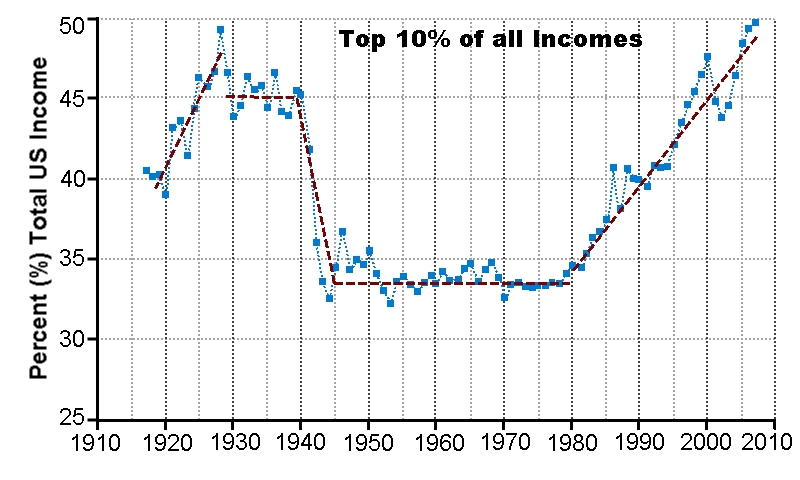
Top 10% incomes 1917-2007  Click for larger image

Things are very bad for those households in income levels at or below median, but still pretty good in the top 10% and better, where the real inequality occurs.

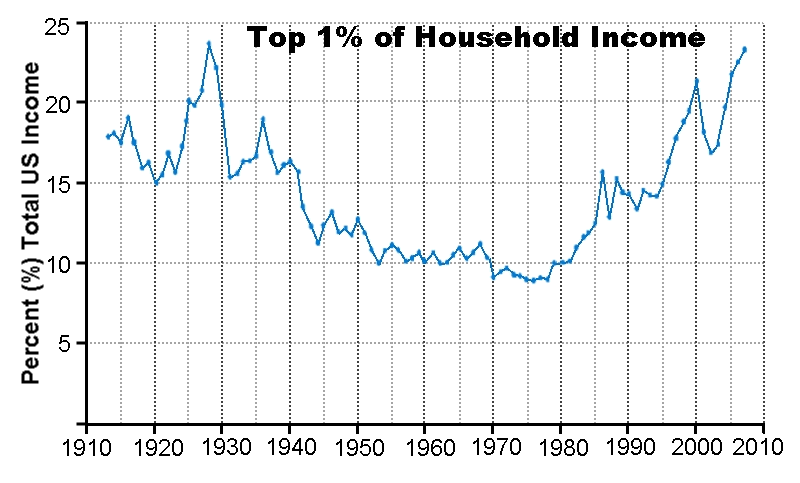
Here are the original graphs from studies that ended in 2007, the last date for the full data sets.

Top1%_gph

Top 1% incomes, 1913-2007    Click for larger image

These data are from Emmanuel Saez (the top 10% and 0.01%) and Robert Reich (top 1%) and are plotted to fit nicely into the vertical graphing windows.

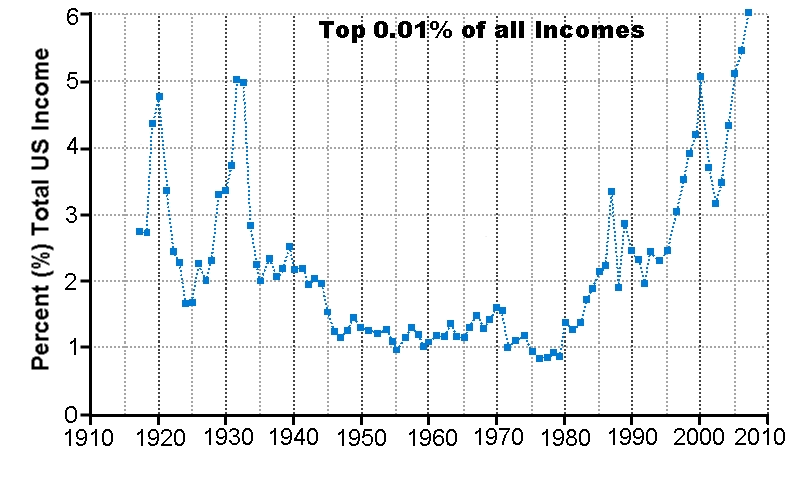
Top0.01_gph

Top 0.01% incomes (1 out of every 10,000 households) 1917-2007.   Click for larger image

The data set ended prior to our ongoing heavy “recession”, and some of the median values have changed; the years 2008 through 2010 show that these top income groups experienced a bit of downturn.

The data for the top 10% appear to have the most spectacular effects, primarily because it is smoother with more households in the 10% set than in the others.

For example, the trends for the 0.01% group are partly hidden by the variation of individual fortunes in this a very small grouping (data “noise”).

Top10TRENDLINES_gph

Top 10 % incomes with suggestive trendlines.  Click for larger image

Rich get richer; the Poor, poorer

Favorite 10%:   Most people like this dataset because it is the smoothest. For example, here it is shown with trendlines added.

Trendlines suggest a narrative about the process.

For example, the time between 1950 and 1980 was a fairly calm, with variations about the flat trendline; little or no overall growth nor contraction during these 3 decades.

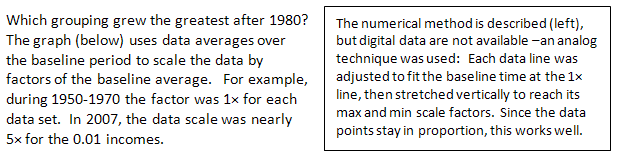
Techniques_txt

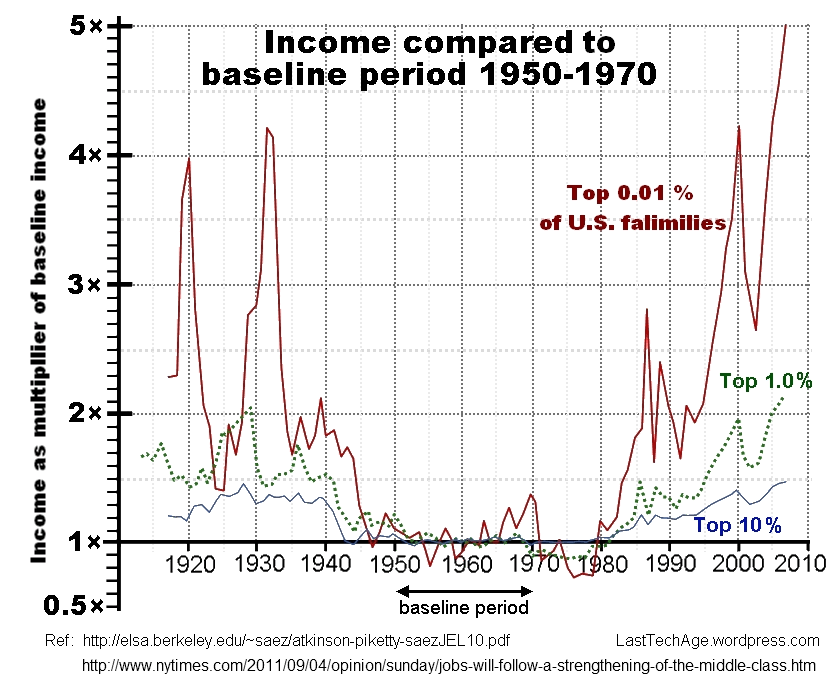
BaselineComparison_gph

10%, 1% and 0.01% incomes compared to basline. Click for larger image

Direct Comparisons show Top 0.01% gained the most:

From this graph, the best upward sloping trendline might start at 1980, maybe later.  Surprise: The Top 10% displayed the clearest effect in the original set, but shows the smallest actual expansion in the post-Carter years.

Incomeshare_tblU.S. Census Bureau trend:  The following table describes the share in total income by each quartile.from baseline time to 2010.   The rich got richer, the poor got poorer.

Note: original post used wrong dataset.  This agrees with Census H02AR

For example, in 2010, the middle third quintile, containing the median income value, accounted for 14.6% of the total income in the U.S.

The baseline average was generated using the years from 1967 to 1980 because the government did not start listing household data until then.

Example: During the baseline period, the top 1/5 of the households had accounted for 43.6% of the total income generated. In 2010, this had increased to over 50%. During the 30 years after 1980, their take of of the total rose by 15% while the bottom 1/5 lost nearly 22% of its share.

Ultra rich·dom gained “big” at Lower poor·dom’s expense
… no net gain for the system.

ClassNamesThe American Aristocracy:   We have shifted from an expanding society to one based on a zero-sum game. 
Top quintile
gained at the expense of the lower classes and probably deserves its traditional “Upper class” label. 
Top 5%
  increased its share by more than a quarter (27%) 
Top 1%
doubled its income (100% growth).
Top 0.01% multiplied income by five (400% growth);  they are too big to fail and are coddled by Republicans and Democrats, alike. They are the ultra-rich, Ultras for short.   This zero-sum-game has huge implications on  expectations of upward mobility.

click for our discussions on economic inequality

Comments: This is a foundation post for the LastTechAge. The trends discussed here underlie all of our problems as a society, including technical excellence.   Check out the summary of all this in our page, American Income Pump, listed, but with many topics left for another day.

Update: 2011 Dec 9  No one in the top 20% earning group feels rich. Why pick on them?  The Poor Rich – Inequality 2

Update: 2011 Dec 11  Our top elites are the job-creators with disproportionate amount of talent. Who says – and whyThe Elite Deserve What They Get – Inequality 3.

Update: 2011 Dec 18  Don’t blame all the uppers, the losses by the lower 4/5ths are the fault of the those at the extreme tip of the earning curve.    Overstated Gains – Inequality 4

Update: 2011 Dec 21   The high gains for the upper 20% actually is driven by the actions of the American UltrasElites or Ultras – Inequality 5 .

Update: 2012 Aug 11 Some of the ‘Ultrarich’ pay $0 for income tax per new IRS data (first ever released about these people with small country incomes, most paid a lot less than their legal 35%.   This, from the news report today by James B. Stewart on the New York Times Business Section front page.  Stewart discusses the top group making more than US$21.7 M,  (LastTechAge ultras have median at US$17M).  Read his report for details…   

……………………………….

Charles J. Armentrout, Ann Arbor
2011 Nov 26.
2011 Nov 27  Changed out Income Share table, wrong data used in original
Have a comment? Click the title of the post, go to the bottom and let us know
Listed under    Economics   …thread  Economics >  Inequality
Find related posts: Click the INDEX tab under the Banner picture.

Posted in Economics | Tagged , , , , , , , , | Leave a comment

Police, Martial Law and new directions

Police are not good enforcers for Martial Law.  Do they serve an over-purpose?

On Friday, November 11, Police in Davis California used pepper spray to quell a quiet group of students participating in the current nation-wide protests.

This never works.  In the 1960’s and ’70’s police in Chicago, Alabama and elsewhere, tried it and radicalized a generation of people and split our society in half; a split that has not healed even today.  Force should be used to stop mob violence, riots that damage and endanger the social fabric.  If this is a martial law situation, then the Army should be called in.  Military population control protocols should be declared and enforced; protocols similar to what we impose on Iraq and Afghanistan.  Do we have riots  currently threatening political big guys, innocent bystanders or properties that need such intervention?  … not yet

Spray_img

Police pepper spray quells violent riot at UC Davis

Here is a frame from one of the many videos taken at that event.  This is from a New York Times report.  The police are shown to casually spray sitting, passive people as though they were spraying caterpillars in a garden.

For people with respiratory issues, this could be life threatening.  For people with just asthma, it could be months for recovery.  Spray normal healthy  people with pepper spray and they develop cold, flu or sinusitis type symptoms that take weeks to get over.

In this video, the brave cop sprays the people sitting with linked arms, bending over to be sure he hits their faces.  He does a second pass to assure compete coverage.  Then a second very brave cop sprays this violent destructive mob of crazies from the rear and heroically assures 360º coverage.  Why not just take these people in and perform partial-death procedures like the water board partial-drowning?

Agonizing force was used; was this really a martial law situation?  For a society to operate well, martial law should be declared with caution.  Was it needed at Kent State (way back when)?  My favorite quotation is from  Adm. Wm. Adama:  “The Army fights the enemy of the people.  When the Army becomes the police, the people become the enemy.”   This is an injunction: do not declare martial law except when extreme force is justified, as with an armed revolt.

LastTechAge has much appearance of a technology blog.  But, its actual goal is to identify what happened in the past to get us to our technically decayed state and point out paths we should follow to avoid losing capability as a people.  My focus is on the my own country, the United States, because human technical development would not disappear were we to accomplish  a social sea-change.  It would move to new centers of excellence, perhaps China and India?

This pepper spray incident is a sign of our times.  My deep fear – Could the goal not have been to halt a serious insurrection movement, but to foment one? This may be an inflammatory accusation, but the 2012 political rhetoric has been filled with secessionist destroy America allusions; kill the beast.  Sometimes candidates compete on who makes the most seditious statements, the most powerful incite-to-riot rhetoric.  (An example is Sara Palin and Glenn Beck’s pictures with target grids over the images.  Palin and Beck are not candidates, so they were free to be more than seditious.  They actually solicited murder.)   Have we entered a new direction in American politics? We appear to be in a new attack on national unity by the same home-grown forces that have operated for the past several generations.

click for more posts on the general directions of our society

Two generations ago, the US was the world powerhouse in new technologies.  Are we now being maneuvered into dissolving our Union?  Once broken into small principalities we would not be capable of coherent technical development.  Once this happened, there would be no point in posts like these about loss of our astrophysical presence, our fusion energy competence, our front-line testing of the foundations of our universe, nor even, biotechnology and medical advances.  As a continent of separated states, there would be no such capability.

……………………………….

Charles J. Armentrout, Ann Arbor
2011 Nov 21        minor typo corrections: Nov 26
This is listed under   General 
Find related posts on the
INDEX  tab, under the Banner.

Posted in General | Tagged , , | Leave a comment

Sudden Jumps and Surging Yen

The yen is not rising with unexpected jumps, it follows a 5 year linear trend.

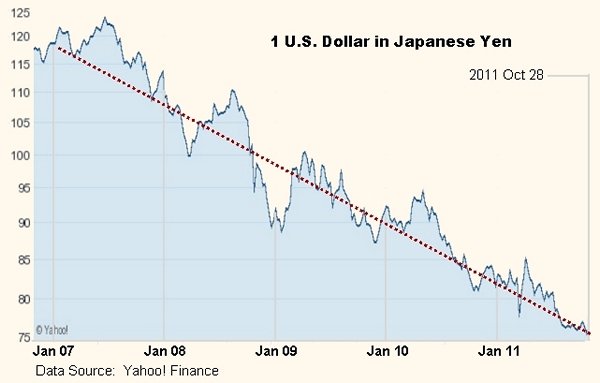
Hiroko Tabuchi published a New York times Business report last Wednesday (2011 Nov 09) on Toyota’s performance.  Ms. Tabuchi is a respected reporter who says Toyota is blaming the surging jump in its homeland currency for its poor recent record. Nice try by Toyota to defend itself.  Such statements make good copy, but the Yen is doing anything but “surging.”

That word in English means to suddenly move forward, to jump or rise abruptly.  It may be a loose translation for the actual Japanese phrase and so my comments might be a bit off target.  But the point is that the Yen has been following an inexorable  linear growth over the last 5 years.   The linear trend is so obvious that I recently wrote an essentially tounge-in-cheek post  on this that predicted parity with the dollar by the end of this decade.

JPYperUSD_gph

Yen/Dollar 5 year history

Ok, as an economist, I am a pretty fair physicist.  But with decades of experience with experimental data, I am pretty good with at it.  Here is the graph I presented in my Yen parity piece.  The downward value of the US dollar  (in Japanese yens) is a long term effect with short term fluctuations.  The effects of government interventions can be seen, but the yen has gotten ever stronger, even during this year’s earthquake/tidal wave/nuclear disaster.   Small  blips, but a strong adherence to the straight trendline.

In the 1990’s I told friends and strangers that GM, Ford and Chrysler’s health depended on the current yen:dollar ratio.  They thought I was paranoid or maybe “quaint.”  At 120 yen/dollar the US industry was faltering and declining.  Once or twice, in those days, the yen reached 100 to the dollar and stayed at this penny yen value for several months.  The US car industry picked right up.  To see the effect, the yen had to be strong for maybe half a year;  the data are sparse because when the yen rose, there were flurries of intervention from both Japan and US.  Huge efforts kept Japanese industry strong, and helped undercut US-made competitiveness.

Nowadays, it is China that is delivering the industrial equivalent of a nuclear attack on mainland US industry.  The US ownership class is shifting its intellectual properties there, not to Japan.  The only ones now effected by the yen are Japanese companies, such as Toyota.  Their products are having to compete with US products at valuations closer to reality and they are feeling the pinch.

The technological success that America has enjoyed has been eroding as we have lost our overwhelming industrial base.  This post is a step toward one I have been working on for some time, the evidence for long term “sea-changes” in our technical capabilities.

click for a list of LastTechAge posts on monitary policy

I am worried that we humans will actually back away from development just now as our resources peak and start to become overwhelmingly expensive.  Are techie stuff to become the toys of the ultra rich?  If so, then we will see a slow back slide to the 1200’s … short lives, poor food, dangerous water, dead children, and the (relatively) wealthy few who will appear primitive if judged by our current standards.

……………………………….

Charles J. Armentrout, Ann Arbor
2011 Nov 14
Listed under  Economics > Monitary Policy
Have a comment? Click on the title of this post, go to bottom, let us know.
Related posts: Click the INDEX button under the Banner picture

Posted in Economics | Tagged , , | Leave a comment

Mercury, Power Plants, poison

Remember our discussion on mercury pollution and fluorescent tubes?  We pointed out that power plants emit about 60 tons of mercury into the environment every year, the nation’s biggest mercury polluters.  EPA has just passed regulations to almost halt all of this, there is huge efforts underway to nullify the regulations.

Nasty Mercury thermometers (targets of a direct Congressional ban) were responsible for about 3/4 ton/yr. Fluorescents were more difficult to estimate, but several different methods indicated that we will be living with a 2 or 3 ton/yr release rate, once the market has reached an equilibrium sales and replacement rate. Good numbers to remember.

Thermometer_imgSen Rand Paul (R- Ky) is diligently working, right now – tonight – to overthrow new EPA rules to stop interstate pollution from power plants, rules that would be extraordinarily effective in dropping the mercury release.  He is trying arm twisting, intimidation, political horse trading… anything to get the 51 votes needed for success.

A new report from  thehill.com came out this evening, The Hill’s Overnight: Energy.  If effective, Presidential Candidate Paul will successfully keep the mercury streaming into our children from the main source of the poison.

The report indicated conservative Democrats Sen Ben Nelson (Neb.), and Sen Joe Manchin (W.Va.) as likely targets.

It is vitally important that Paul’s effort is not successful.   The effort is based on an older 1990’s law Newt Gringrich got through that allowed a congressional vote to override EPA actions.

CoalPower_imgThe issue is that it would be expensive to put in the scrubbers to clean up emission.  The coal  burner installations would become as expensive as a nuclear plant and huge profits would be lost to remediation.  The current EPA ruling is not sudden.  This was discussed in the late 1960’s, even, when the power companies waxed eloquent and donated heavily to stop it.  So, this is 40+ years  they have dumped mercury into our food stream and took home great margins.

click for LastTechAge posts on environmental pollution

I am just adding the LastTechAge voice to all the others that are speaking on power plant emissions.   I am a trained pessimist, though.  I have watched the US turn away from many good technologies by use of maybe a buck under the table, perhaps other techniques.  I have grave premonitions that this will end as the arch-reactionaries wish, not as we might wish to  benefit to our children, and our children’s children.

Update: 2011 Dec 27   The EPA finally issued is 20 year delayed rule to limit power plant emissions.  The EPA Limits Mercury In The Environment

……………………………….

Charles J. Armentrout, Ann Arbor
2011 Nov 3
Listed under    Natural Resources      …thread   Natural Resources >  Pollution
Have a comment? Click on the title of this post, go to bottom, let us know.
Related posts: Click the  INDEX  button under the Banner picture

Posted in Natural Resources, Technology | Tagged , , , , , , | Leave a comment

When Yen Parity?

The Yen is rising in value vs. the U.S. Dollar, could we make a guess when 1 dollar is the same worth as 1 yen?  Such a guess would be purely speculative and work only if “past history is the best forecaster of future behavior.”  Which is certainly untrue.  All that not withstanding, we will have a try at it based on an interesting observation.

The Japanese Yen has been strengthening against the U.S. dollar in bursts, pauses, and  jiggles of various sorts.  Recently, it appears to have been relatively constant with a bit of a drop on Friday, 2011 Oct 28  (look at the published daily charts in the New York Times newspaper) .

JPYperUSD_gph

Yen/Dollar 5 year history

Since extrapolations of yen valuation could only be done if we could see visible trending, here is an interesting graph.  I will post this twice, one of the raw data and one with a trendline drawn in.  The graph here is from the Yahoo! Finance section and shows the cost of 1 U.S. dollar in yen from the start of 2007 through Oct 28, this year.  Click the graph for an larger version.

Trendline_gph

Straight line approximation to the same data.

The data graph shows such a relentless rise in the value of the yen that we are tempted to draw in a trendline.  The line is hand-drawn, to guide the eye.  I did not do computations to get it, and would guess it is within 20% of a least squares calculation.   Any conclusions we might draw would have larger uncertainties than that!

But the data do show that yen values have been rising rather dramatically during the global recession.  The rate of decrease in yen/dollar (ypd) is  about 0.9 ypd per month [ = (118ypd – 76 ypd)/(47 months) ].  The yen exceeded the US penny sometime in 2008 and has kept on going.

Suppose the yen continues this appreciation.   This may not be a horrible assumption; it did continue its growth throughout the recession and even after the Fukushima disaster.  To reach parity, it must appreciate through 75 ypd to reach 1 yen per dollar.  Use straight line projection: Δypd = rate * Δmonths, the time needed is M= 75/.9 = 83 months.

So if the Japanese keep as the economic powerhouse that they are, one yen will be worth 1 US dollar in 7 years (=83/12).   This means we should hold the parity party sometime about 2018 or 2019.

What if our estimate of this is 30% too fast so that our 7 year result should be 9 years.   This would mean our party would be held in 2020.

click for a list of LastTechAge posts on monitary policy

Now let’s get real.    In my classes, I teach that no data set can be reliably be extrapolated beyond  maybe 10% of its data window (1/2 yr for our 5 yr window).  This does put a bit of damper on our enthusiasm for expecting the dollar-yen parity party by 2020.   So do not hurry out to get rising sun bunting, whistles or party hats any time soon.  Does this have anything to do with technology?  Ha!  I am not even sure it has much to do with economics, either!   But it is an interesting bit of fun.

……………………………….

Charles J. Armentrout, Ann Arbor
2011 Oct 29
Have a comment? Click on the title of this post, go to bottom, let us know.
This is listed under   Economics
Related posts: Click the INDEX button under the Banner picture

Posted in Economics | Tagged , , | Leave a comment

Pipeline spills and Keystone XL

Pipeline spills are common about the world and certainly in the U.S.  This post is an adjunct to LastTechAge major post on Keystone XL, bringing previously published data into view again.

NYT-PipelineSpills_map

Part of pipeline spill graphic (see New York Times)

Here is only part of a New York Times graphic published under the bylines of Dan Frosch and Janet Roberts, both excellent reporters following environmental issues. In their 2011 Sep 10 report, they showed that pipeline spills are common.  Click on that article for some interesting data.  (For example, the Michican spill by Enbridge Energy discussed in our previous post lost over 800,000 gallons of oil and will cost over half a million dollars and well over 2 years to clean up.)

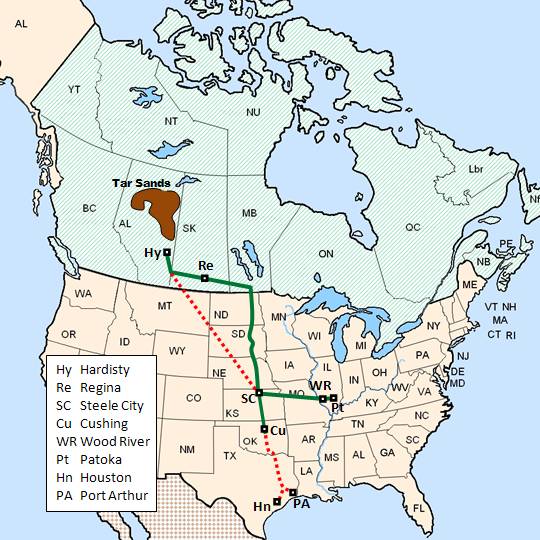
Keystone-Ogallala_mapFor reference,  here is a repeat of our map of the Keystone XL project.  It is an add-on to the Keystone line that became operational in February of 2011 (this year).  The current (new new) Keystone ships bitumen slurry to refineries in the U.S. Midwest.  The proposed changes or additions are meant to bypass these refineries, and send a larger volume to the Gulf coast for refining into synthetic crude, and then to the supertankers at our deep water Gulf of Mexico ports.

This map shows the current Keystone in dark green and the dotted red line is Keystone XL. The source of bitumen is in northern Alberta, CA.  There a bunch of other companies operating pipelines, too.  This map shows the path through the major Midwest aquifer, the Ogallala (several million years old and endangered even without oil spill.

Compare these two maps.  The Keystone pipelines and the other lines all run through the Ogallala, and have been leaking throughout.  Now just wait for the map after XL is up and running.

As U.S. citizens, we cannot criticize Canadians about their oil mining policies.  If fact, the hostility is so great that we would risk causing them to draw into a defensive circle, if we were to do so.  But we have one of our principal water sources at risk.  The tar sand product is unusually dangerous,  because the fluidization technique uses naptha to produce the slurry.

click for a list of our posts on KXL

We as a nation have nothing to gain in energy security or long term jobs.  Keystone XL is a way to move product to shipping ports and must be viewed as such.  We have much to lose.   Based on his response to the banking failures of ’08-’09, I would give 10:1 odds that Obama will approve this deal.    Too bad for our children.

Update: 2013 Jun   Ben Stein says worrying about water contamination is for the mentally deranged.  Our response  in Water, Groundwater and XL.

……………………………….

Charles J. Armentrout, Ann Arbor
2011 Oct 28
This is listed under   Natural Resources   …thread  Natural Resources >  KXL
Find related posts in the 
INDEX  tab, under our Banner

Posted in Natural Resources | Tagged , , , , , | 2 Comments

Free Trade is Bad for U.S.

Last night, the magazine The Hill  posts current notes on items of immediate concern.   Today, sometime, Pres Obama is to sign the Free Trade bill and send more factories, more jobs overseas.

This agreement is with S. Korea, Panama, and Columbia.   The idea has a lofty sound, but has been a disaster.  I believe there are major omissions in all our “free trade” agreements

None of the Free Trade Acts, starting with Clinton’s NAFTA, have had any clause requiring the features that make U.S. goods specially safe.  No OSHA requirements, no EPA, no FDA, no real quality assurance, no minimum wage.  The items we get back are as cheap as physically possible to make, and may be just short of outright murder weapons in consumer danger.

click for all our discussions about trade policy

America has moved toward a boss’s heaven.  Think.  We can shift our factories to one of these countries and close down our U.S. versions.   Then ship in items produced by near serf labor.  So what if field hands work in insecticide plumes from the planes buzzing overhead?  Not our problem! So what if cheaper pharmaceuticals and processes are substituted for the original items? The  origin country does not care about such issues; we have no say in the matter.

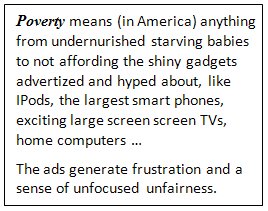
Poverty_defThis is a travesty, likely to reduce most of our population (below median income) to poverty.  The U.S. median family income (the income where 50% of the U.S. families earn below this value) dropped again and is now a bit less than $50,000.  It is interesting that Note that most who make $200,000 in this country call themselves Middle Class.  What does”middle” mean here? What would they call the 50/50 break point in income?   $250,000 is a nice round average salary for the leaders of struggling not-for-profit organizations.  70 or so years ago, company owners made 5× median.  Now it is lowly 501(c) presidents that do.  Note, the $50 thousand value is for family incomes, not individual ones.

Without reciprocal controls over the making process, we cannot assure that our people’s interest will be protected.  This is almost certainly what Clinton, Bush and Obama had/have in mind.

Here is my experience from the last decade. About 6 years ago, I was working with an independent sales company in Michigan.  We visited the Eaton plant in Saginaw, MI, (Saginaw was one of the main dynamos of U.S. manufacturing after WW-II). That day, Eaton was moving to Mexico.  I met a line engineer as she trained her replacement on her own line.  Her program was being dismantled and moved out;  it would soon be his.  Eaton told the engineer she would loose all unemployment benefits if she did not train her Mexican replacement.  Do you feel her pain here? Or, do you side with her MBA boss? Maybe this was all her fault for getting too high a wage?  Eaton has long  gone from Saginaw, but they did not leave because of the wage structure. Mexico does not have the protections on health, safety, and environment that American plants benefited from.  Even so Mexico may be one of the better countries.  Heaven be on your side if you work in Bolivia, or Bulgaria.  What about Panama and Columbia?

The LastTechAge is focused on our loss of technical competence over  the past decades.  Although free trade agreements are not overtly technical issues, if we do not have the manufacturing plants, we can not have the engineering support that goes with each one. If we do not have the engineering, we cannot come up with the next generation of spectacular inventions, because the inspiration for that comes from focusing on manufacturing innovation.   The more we “outsource”  and award business school grads with top executive jobs, the less we control and direct (in an engineering sense) with the changes in the products being invented.

We are in a  downward innovation spiral and one of the forcing factors are the Free Trade Agreements.   To stop this, someone in Congress must get a law passed that no one may import into the U.S. unless they demonstrate that they follow U.S. standards.  Such an act alone would do much for our competitiveness but it would need legal teeth.

Today, October 21,  is another dark day in the downward motion toward a future we need not have faced.

……………………………….

Charles J. Armentrout, Ann Arbor
2011 Oct 20
Have a comment? Click on the title of this post, go to bottom, let us know.
This is listed under    Economics
Related posts: Click the INDEX button under the Banner picture

Posted in Economics | Tagged , , , , | Leave a comment

Keystone XL – The Balance Sheet

The U.S. will soon make a decision on to allow the build of the “final” segments to the Keystone pipe line, or not.  This proposal is called Keystone XL by TransCanada Corporation. It is to replace parts and to build an extension of its private pipeline for transporting a petroleum fluid (bitumen slurry mixed with naphtha for pipeline transport) to the Texas coast on the Gulf of Mexico.  Keystone is not unique; there are other competing pipeline companies with currently operating lines to other parts of the United States.

KeystoneDisclaimer_txtThe decision path now passes through Secretary of State Hillary Clinton who will pass her recommendation to President Barack Obama for his decision.  Expect resolution before the end of the year.

Jump to Keystone Description, History, Considerations ( Relaxed Standards, Increased leakage, Environmental Damage National Security ), and Assessment.

——————–
Keystone Description

Keystone_mapThe Keystone XL issue is over a new short cut around a current portion and an extension to the Texas coast.

The current TransCanada Keystone line, shown in green, originates at Hardisty Alberta leads to Steele City Nebraska.  It splits Eastwards to refineries at Wood River and Patoke Illinois, and Southwards to Cushing Oklahoma.

In this map, the XL upgrade is the dotted red.  The tar sands region is the brown pool in northern Alberta.

——————–
History and background

The 2150 mi (3460 km) pipeline was first proposed in 2005 to be done in 4 phases.

KeystonePhases_tblFlow_tbl
Phase 1 and 2 can carry up to 3% of maximum US demand.  The XL proposals will increase the pipe diameter and allow transport of up to  5.5% US demand.

Current US demand has dropped from the peak value of nearly 20 M bbl/d.  Fox News must be pleased:  all that is needed now is to terminate all  jobs and our entire demand could be met by those friendly Canadian suppliers they talk on about.    I used a maximum demand of 20 M bbl/d.

CAN-Resrv_gph

Canadian proven reserves jumped in 2002.

Canada started tar sand development less than 10 years ago when the geological size was confirmed.  Previous to this recognition, Canada’s petroleum resources were crude oil deposits that can be pumped.  The new source is bitumen, whose properties range from very cold molasses to soft rock (a kind of coal) and mixed through a sand bed.

Bitumen sources cannot be pumped, they must be strip mined as ore. Most of Canada’s petroleum supply is in this form.

The US EIA estimates a total reserve of about 175 G bbl of petroleum, making it the third largest source after Saudi Arabia and Venezuela.  This is down from an earlier proved resource estimate.  This is contentious: oil companies estimate the Canadian reserve at 2 T bbl., equal to that of the reserves from the rest of the entire world. My view?  EIA tries to get the base data, Corporate execs try to sell stock. The Canadian bitumen reserve is huge, no matter who wins the estimation argument.

——————–
US Considerations

In all the other categories of petroleum reservoirs we have examined, the size of the reserve did not warrant the damage and disruption that would be required to tap it.    The “too-small-to-justify-damage” argument is not the case here.

Canadian resources are the responsibility of the Canadian people, and there is strong controversy there. Converting half of Alberta into sludge waste is their issue; we have lots of our own, including hydro-fracking Pennsylvania groundwater and other super-toxic waste areas in the making.  The only U.S. XL decision is whether or not the current 590 G bbl/day supply should be increased to 1.1 M bbl/day and sent to the great shipping ports on the Texas coast.

Pipeline_img

A segment of petroleum pipeline

——————–
What is at stake in our decision?


• Relaxed Standards — TransCanada has petitioned to use extra thin tube at extra high forcing pressure.   Their desire is to enlarge the diameter for higher throughput, but the larger pipe is pretty costly with the usual wall thickness and they want to thin out the walls to help profits.

The fluid is grainy and frictional compared to crude, the increased pressure is needed to assure the flow.

BitumenSlury_img

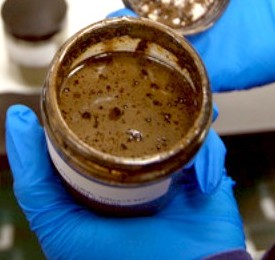
Results of inital process — coarse coal-like lumps in a slurry

The material pumped through the pipe is not crude oil, as sometimes stated, but a slurry, of little chunks of coal-like bitumen, see the New York Times image from an Alberta processing facility.  The U.S. EIA calls this a petroleum product, and one makes synthetic oil from it.  The system transports fluids more reactive than oil, in pipes larger diameter than usual, using thinner than normal walls, and higher than normal pressures.  We should to demand ultrasound and/or x-ray wall inspection several times a week, along almost every inch of the entire route, for as long as the pipeline is standing.

Relaxing standards might not sound like issue, but the new tubing has had only limited trials.  Even standard tube generates copious leaks, as demonstrated by operational history.  TransCanada, itself, has had 12 leaks, mostly minor, in the shiny new Phase1 and 2 segments. Competitors, such as Enbridge, a Texas based pipeline company, has had many leaks all over the continent.  Note that Shell Oil bragged about the safety of their offshore wells during its application for Arctic sea drilling.  Then it turned out they had been covering up an on-going leak at a North Sea well.

Ruptured oil lines may not sound like an issue if you live far from the pipeline, but it is hard to do without water if you are local.  Enbridge, a competing pipeline company, had a rupture in July, 2010, about 100 miles from my house.  This oopsie leaked down creeks and streams into the Kalamazoo River.  Our news was full of local upset due to the damage.  Remediation will take into 2012.


Hubbert-TarSands_txt • Increased Leakage — Ok, so maybe there will be increased leakage, per the last praragraph.  Who cares?  It is pretty flat and empty out in the American midwestern plains.   We all should care; This plan threatens the richest agriculture region in the world with potential destruction.  Per M. K. Hubbert (sidebar) we have the option to reject the argument “these are bad times, resources must be drained, and maybe bad things will happen. Live with it.”

Leaks could/will happen, especially if several things go wrong a the same time.  Think U.S. Northeast power outage of 2003, 3 mile Island reactor core melt and, especially, the Japanese Fukushima issues of March 2011.  Our safety systems are good at single, isolated events, but are overwhelmed by the inevitable simultaneous multiples.  Suppose such a complex of events happen and cause rupture at many points along the 2000 mile length. Suppose the damage were to release an Exxon Valdez sized volume of nasty, extra acid bitumen slurry.  Would there be any consequence?


• Environmental Damage — TransCanada proposes the XL extensions over one of our most vulnerable water resources, the Ogallala aquifer.

Keystone-Ogallala_mapOgallala is the light cross hatched puddle region near the center of the US.  (Click map for larger image.) The major rivers that pass through and near it are also shown.  The underground water reservoir formed 2 to 6 million years ago, refills slowly,  and is already in danger due to heavy draining during the last 50-100 years.  It is the source of drinking water for the cities and towns in the region and supplies 30% of irrigation. The Ogallala is 1000 ft deep at its richest Northern extent in Nebraska and 100 ft deep in Texas.

The XL project would cross at its most abundant region.  Who knows where the acid waste would drain to.  Recall the Enbridge example where small local creeks poisoned a local waterway in Michigan.  Now look at the waterways that are crossed by Keystone. If you do not see the threat, your visualization ability is faulty.


• National Security — There are a number of arguments here:  We need friendly suppliers, Canadian oil is required to fill our tanks, Alberta product should come to U.S., buy Canadian to keep oil from going abroad;  furthermore, it will provide jobs where they are really needed.

We need friendly suppliers.   We really do not want to become serfs of unfriendly nations.  This propaganda is grossly misleading at several levels.  Mostly, oil producing nations use private enterprise to sell the oil.   Each of these is as greedy or as high minded as any company.  For example, the Canadian companies are as friendly as the leaders of Aramco.  They are in the business to make money.  period.

The difference between the current 590 thousand barrels/d and projected 1.1 Million barrels/d is 510 thousand barrels/day. At $100 per barrel, this is $51 million gross in sales every day and a toasty net receipt for the bosses. (If $85/bbl, 0.85*51= $43M/d)

Friendly?   Leslie Kaufman and Dan Frosh published an article in the New York Times, Tues Oct 18, 2011 p A11, also on the NYT site.  Our friendly TransCanadian Pipeline company is using eminent domain actions to confiscate U.S. land for the Keystone XL upgrade, even though it has not been given U.S. approval.  The Canadian company is trying to take land from US citizens from Wyoming to Texas.  They are using the wholly owned U.S. subsidiary to do this, but at the direction of the Canadian executive board.  This is a fascinating story for those who like such things.

We need Keystone for access to Canadian crude.   This is a pretty self-serving story (to be polite).  First, what is being piped is not oil, it is a slurry of bitumen, a type of coal.  Second, this stuff is already coming into our country through many lines.  The  TransCanadian Keystone is only one.  Enbridge (of the Michigan leaky-pipe story) is another.  Canada is our largest supplier of petroleum products and virtually all is from the tar sand mining.  The Keystone XL proposal is to let only one of the several companies increase its throughput on one of its lines from 590 billion barrels/day to 1.1 million barrels/day; this particular single line is to provide access the shipping ports on the Gulf coast.

The in-place Keystone pipeline currently transports product to refineries in the heart of the U.S. Midwest.  The XL extension is meant to bypass these and take it straight to where it can most easily loaded onto ocean freighters.  Loaded, of course, after processing the slurry into a synthetic crude oil.  It is dirty-processed in Alberta so it can be piped.  It is not-so-clean final-processed at the pipeline terminus to make it usable as oil.  This stuff is not dedicated to U.S. use.  It is similar to the current attack on our Strategic Petroleum Reserve; we are not draining our stored cheap oil because America needs it so badly.  (It is going to international markets for huge profits).

Canadians want to sell to us Americans, but will sell abroad if rejected.   If they are not already selling abroad, why are there lines to the Pacific coast?  Why the lines to Superior, Wisconsin on Lake Superior?  Naturally they are currently selling abroad even as they sell to us.  These are businesses, of course.

Jobs!   This comes up again and again.  The XL project will be a big construction push down the length of the US Midwest.  If it were to start in 2012, the company estimates completion by 2013.   For a mere 12 months of work, (even with the rather good pay that is given) should we destroy the source of water in the Midwest farming country (ref. Ogallala, above)?    The jobs issue is a matter of size.  If it were to supply a permanent of middle class wage base for everyone in the the entire population of the region, I would be hard pressed to not say YES. If the payback were too small, the answer is an obvious NO.

Keystone XL upgrade is so short, will hire so few, and is has near certain potential of permanent damage that this is solidly in the NO portion of the decision spectrum.

——————–
Keystone XL Assessment

Good arguments against Keystone XL     There is no need for an unusually high-risk pipeline to cross the aquifer we depend on.    There is no need to make it easy for the company to make tidy profits selling oil shipments from the Gulf of Mexico.  There is no long-term benefit to anyone living in the region.  There is actually no real incremental benefit to U.S. citizens in the proposal.

Bad arguments against KXL     The Alberta operations is dumping carbon into the atmosphere, or toxic wastes into awful pools in Canada. Both true but as much as we wish, we do not affect Canadian mining, US citizen action will never change the mining activities there.    We do not need the oil because our demand has dropped and there are wonderfully efficient new technologies on the drawing boards.  True,  but demand is related to the economy;  drawing-board chickens are always unhatched eggs.

click for a list of our posts on KXL

Keystone XL is just not in our National interest.  But it does involve massive profits for the owners.

Pres Obama will be picking winners among the super rich families when he OK’s this project.

Note added in proof: On October 18, 2011, the website of  The Hill magazine posted  info on a new request from Henry Waxman, Ranking Member of the House Energy and Commerce Committee. It is a request for investigation into the relationship between the Keystone XL project and the very rich, “conservative” Koch family.  This is a very important facet to the project, if investigation proves true.  Conservative is in quotes because Charles and David Koch are pressing a radical agenda (as in radical surgery) to transform the U.S. into a feudal state or maybe “states.”

Update 2012 Mar 10:  (A) Reuters has a good discussion on the the constant buzz that Keystone is a new pipeline to go where none has gone before.   (B) Nice discussion on NPR about U.S. activists’ thoughts that stopping XL could stop Canada from destroying the Alberta environment and help stop global warming.  My own view remains  that we in the U.S. must not get involved with the raging Canadian fight over shale/tar sands exploitation.  No one likes outsiders telling them what to do – American preaching sounds like American domination; we might generate even more environmental damage.

……………………………….

Charles J. Armentrout, Ann Arbor
2011 Oct 19
Have a comment? Click on the title of this post, go to bottom, let us know.
This is listed under    Natural Resources    …thread Natural Resources >   KXL
Related posts: Click the INDEX button under the Banner picture

Posted in Natural Resources | Tagged , , , , , , , , , , , , , , | Leave a comment

Update — Fluorescent Lights / China

This is an update on the law banning incandescent lighting, see Using Fluorescent Lights -A Compilation.   The New York Times (2011 Sep16) had an article by Keith Bradsher in the Business section,  China Consolidates Grip on Rare Earths. The Chinese shut-down of rare earth elements is having a real impact on western nations.

Rare earths are elements are vital for the phosphor screens (light generation) and emission coatings on the filaments that stimulate the mercury to start the process.  Availability has drastically decreased, causing the price of compact bulbs to pop up like a jack-in-the-box.

The article quotes a GE press release comparing the price increase to a $2.00 cup of coffee.   With the same raw material price increase, such a cup would cost $24.55.  The actual prices of bulbs, though, have “only” risen about 30% because most costs reside in the cheap parts, ultra low labor, and handling throughout the sales chain.  If rare earths became totally impossible to obtain, CFLs would just not be expensive, they would be gone; nominated for inclusion into our “Technology Scene” category.

The current 3 month shut-down is explained as a means to allow mines to install pollution control equipment.   That is nice, Chinese mines are world renown for the poisonous local wastes they generate, and the lives they take for convenience. I am sure a bit of cleanup will be appreciated by the peasantry dying by the sludge ponds.

China is the main source for many CFL bulbs, as had been commented here many times (for examples, click Categories on the right side of the screen,  click Technology, then look at Fluorescents 1 and 4A).  We have a major issue – we have mandated the US ability to generate indoor lighting be subordinated to a single country, the People’s Republic Of China.  Clinton, Bush/Chaney and Obama allowed/encouraged the shutdown of U.S. bulb and tube manufacturing and the shifting of the root technology across the sea to China.

Now we are by law, at the mercy of these communist super-Capitalists.  My, my! What 40 years can do to a person:  Passionate ideologues for the Great Leap Forward at age 20 banishing intelligentsia into the countryside to die, rich owner with many serfs at age 60.  But always true to Chairman Mao, I am certain.   Am I pushing too much on China? Some folks think so.  I think we have placed ourselves in their not-so-tender mercy   …  since we can no longer build things for ourselves, the situation will only grow more aggravated.

Note that this rare earth withdrawal is currently hurting us mostly in the price of CFL bulbs. (The NYT print edition had a typo about this, read the on-line update.)  If extended, we will not be able to build our microcircuits, and this will affect new generations of cell phones, pads, laptops, high efficiency cars, … and so on.  When this shortage hits the consumer market we will see serious withdrawal of services and choices.

click for a list our posts on illumination technology

CFLs are so wonderfully bumper sticker green.  CFL adoption is not a political alignment issue, although reactionary Tea Party crazies are against them out of elbow-jerk reflex.  The utopian argument is FOR — If only everyone did what was best, CFLs would make life beautiful.  Whatever.

CFLs will be only choice in the nation next year, so be happy.  Come 2012, our survival will take the next step in its dependency on the Chinese hegemony.

……………………………….

Charles J. Armentrout, Ann Arbor
2011 Sep 18
This is listed under   Technology     …thread  Technology >  Fluorescents
Have a comment? Click on the title of this post, go to bottom, let us know.
Related posts: Click the INDEX button under the Banner picture

Posted in Technology | Tagged , , , , , , , | 2 Comments

Arctic Off-Shore Oil – is it worth it?

There is a lot of talk about off-shore oil in the Arctic.  In August, Shell Oil was given the final  green light to sink test wells in Beaufort Sea, located in the arctic coastal waters off Alaska, just off shore from Prudhoe Bay drilling site and ANWR wildlife reserve.  Shell announced that it would begin activity in 2012.

ArcticOil_map

Potential fuel locations in the Arctic

A 2008 US Geological Survey (USGS)  report estimated that up to 90 G bbl (billion barrels, US) might exist in a region bounded by the arctic circle.  80% of this might be under the sea bed.  View the map as a clockface:  Alaska is near 11:00 and Russia is 12:00–4:00.

Map:   from Fossil fuel resources and oil and gas production in the Arctic. (2007). In UNEP/GRID-Arendal Maps and Graphics Library. Retrieved September 2, 2011.   Cartographer:  Philippe Rekacewicz & Hugo Ahlenius UNEP/GRID-Arendal)

How much oil and natural gas resources actually reside in this area?  Is it worth the danger to the ecosphere to drill in this region?    The answer is – not.

Jump to The RegionThe Potential,   AnalysisConclusion

——————–
The Region

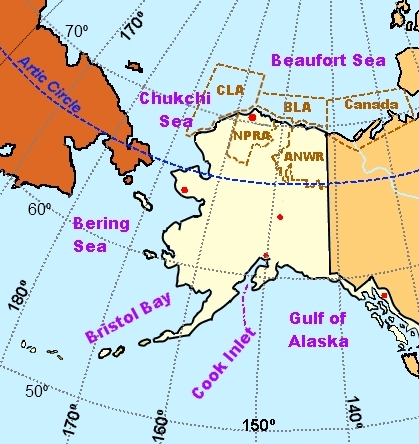
AlaskaOil_mapThe region in U.S. and Canadian waters is shown.  The 5 red dots are cities.  Barrow in the North, Nome in the Wast, Anchorage is South at the end of the Cook Inlet, Juneau is in the South East.  Fairbanks is near the center, close to the TAPS pipeline between Prudhoe Bay (North) and Valdez, not shown but on the shore East of Anchorage.

The areas of interest are the Beaufort Sea and the Chukchi Sea whose international boundaries are not well defined, though the Chukchi/Beaufort boundary is in US territory and undisputed.  CLA is the US Chukchi Leasing Area; BLA is the US Beaufort Leasing Area.  The US-Canadian Beaufort Sea boundary is a region of stress caused by the USGS oil estimate.

The site marked “Canada”  is up for licensing but seems to be a bit slower than the U.S. efforts.  The Canadian river shown is the McKenzie river and there is a lot of interest for exploratory wells in the McKenzie delta.   The Shell claims are mostly in the waters North of ANWR (Alaska Natural Wildlife Reserve), and North of NPRA (National Petroleum Reserve, Alaska).   Prudhoe bay, the site of oil production for the past 40 years, is on the coast, between the NPRA and the ANWR.  Check our previous analysis of NPRA and ANWR.

ManmadeIsland_img

Northstar pumping island in Beaufort Sea (Summer)

Off shore pumping rigs would be located on special man-made islands or huge ice-breaker type pump ships. The ships would disconnect every autumn and reconnect the following spring (think BP Deepwater Horizon incident). The oil would be transported via the TAPS pipeline (Trans Alaskan Petroleum System) to the south coast near Valdez, then by tanker to the world markets.

——————–
The Potential

Ken Salazar, Secretary of the Interior,  released a recent report on potential undiscovered off shore oil reservoirs.  We will use these numbers, along with current usage from the U.S. EIA.   The world uses 87 M bbl/day or 32 G bbl/yr (1 G bbl is 109 barrels, called a billion barrels in most of North America.)

OCS_TBL

Outer Continental Shelf Resources

The estimates are given as ranges of values: high value is the least likely to be realized, low values have the highest chance of being met.  The average between these becomes the “probable” reserve value. The Chukchi Sea estimate was so broad that we just quoted the range as given.  We are missing the West coast estimates and we can discuss these in a later post.

Methodology for the “average” value.  The Arithmetic Mean  AM= (High+Low)/2 is used as the table average value.  The the high and low values are equal percentages above and below the AM.  The Geometric Mean GM = √(High×Low)  is the average used by people who do semi-professional estimating.  The high is a factor k above the GMHigh = k·GM;  the low is the same factor k below the GMLow = GM/k.  In most of our averages needed to estimate the extraction lifetime for a resource pool, GM is less than  AM —the AM is the more optimistic.

——————–
Analysis

PkProduction_tblThe list on the right is used with the reserves table (above) to give an estimate of the effect of pumping the the offshore fields might affect us.  Extraction occurs over 30 years, the factor 3 in Peak Production follows detailed modeling results for the  ANWR study.

Example  BLR has a Probable Reserve (from table) of (2+7)/2 = 4.5 G bbl.  Probable extraction rate  = 4.5 G bbl/30 yr = 150 M bbl/yr.  Peak production would be 450 M bbl pumped for a couple years maybe 15 to 20 years after the pumping started. Suppose you are optimistic and use the High =7 G bbl, with overall average production of 230 M bbl/yr. This would set peak production at 700 M bbl for the several peak years(10% of annual U.S. demand).

UseTime_tblEstimate Highest Impact    If all oil went to the U.S. the peak impact would be (450 M)/(7000 M) = 6 ½% (current usage is 7 G bbl/yr).   If all this went to gasoline availability costing $4.00/gal (US), you might see (during the 2 or 3 peak years) a 4½% decrease, to $3.82 per gallon.  This is most that we might see.

After the peak in production, extraction becomes more expensive and volume drops.  The peak would happen no sooner than half way through production, following the Prudhoe Bay experience.

For comparison, ANWR (≤ 10.5 G bbl) might have as much as 1½ year of oil at U.S. current rates; and the NPRA (≤ 0.9 G bbl) has a pitiful supply of only a few months of petroleum under its tundra.  To apply these methods to any petroleum site, use US usage is 7 G bbl/yr and World usage is 32 G bbl/yr.

There is not much petroleum there, though the the USGS estimate of 90 G Arctic-area  barrels generated a lot of interest because billion sounds large.

Here is the dichotomy:

  • Potl-Lifetime_tblNot much arctic oil exists.  Oil has been in ever-growing usage for the past 150 years. Civilization needs to maintain such an increasing use rate for tens of decades if we are to retain our technical world (at our demonstrated current concern for our survival).

Significance_defIt is easy to become lost in the lies of large numbers.  My own rule is shown here.   A  World Significant oil supply would hold 320 G bbl (10 years at 32 G bbl/yr).  A supply is  American Significant  if it contains 70 G bbl (10 yrs at 7 G bbl/yr) and is dedicated to American consumers, only.  Any interest can extend this to their own clan, group or country.   Strict laws would be required to limit distribution and usage to that one interest group.

Lies_defThere is not much arctic oil when you think about supplying the needs of civilization. World usage is less than 3 years for all the oil in the arctic.  The lies of large numbers hides this, 90 billion barrels sounds wonderfully huge.  A 3 year supply, spread over the next 30 to 40 years during the extraction lifetime is incredibly small.

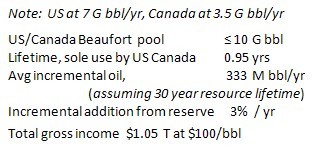
  • ArticValue_txtHuge profits are possible.  A treasure is buried in the arctic circle, just waiting for someone to carry home.  (Note: August 2011 price is about $87/bbl, so multiply 9 trillion by 0.87 for a current 7.8 trillion dollar income.)  Average this over the 30 yr extraction period:  260 G$/yr.  The profits from this income go straight to the corporate operators (executive staffs and boards of directors), those in the 0.1% of the population of the developed world, not to the world population in general.

Advantage_txtFocus the dichotomy on US/Canada. Now discuss our best interests, not world-wide ones. The Alaskan/Canadian Beaufort basin has less than 10 G bbl,  less than a 1 year supply if all went to U.S. and Canada spread over the 30 year service life of the pumping effort.   This would bring in $1 T for every 10 billion barrels to be found ( a cool 30 G$/yr as the 30 yr average).  Sell throughout the world (as would actually happen) and, during a 30 year production, the added supply of oil would not be noticed by consumers anywhere.

No national security issues are involved.  There is too little impact to make any difference to the countries involved.  We are moving to exploit the resources for the personal gain of a handful of families.  It comes down to that.

That bolded lead statement is not quite right. Under normal use, no one would see any kind of lasting effect.  But during time of war, when our lands and people are threatened, when our high tech weapons are about to run out of gas, this resource might make the difference in crucial battles.  Yes, there are very clear national strategic reasons to not drill and pump now and to hold the reserve for the certainty of upcoming  need.  This is the same argument for not drawing down the U.S. Strategic Petroleum Reserve.  You can make someone richer, but you cannot make anyone happier nor safer.  National security arguments generally loose to robber baron politics.  Right now, we are in the middle of an SPR drawdown and hear satisfied burps from oil company board rooms.

Devastated if we do.  The downside of Arctic development is nearly certain environmental devastation.  BP had real problems fixing its 2010 Deepwater Horizon leak in the balmy Gulf of Mexico.  Drilling north of the Arctic circle will require techniques hundreds of times more difficult.

ShellOilSpill_img

Shell Oil spill site, North Sea 2011 Aug

Shell Oil was awarded the Beaufort Sea exploration license, they are to start in 2012. Here is a comment from the L.A. Times.

This is troubling, not because Shell has a worse record than anyone else (it doesn’t), but because this past summer  Shell hid even a minor leak at one of its North Sea stations.

Shell tried to cover up a not-huge North Sea leak … what kind of behavior should we expect from them in the even harsher environment of the true arctic?

Clean-up is hard even off the coast of France.  In arctic waters, it may be impossible.  There has been some recent response to a very poor arctic clean up strategy,  see for example  The Guardian (UK) , Independent (UK).  We could easily reference a thousand discussions.   The point is the consequence of arctic spills and clean up attempts, is very reminiscent of nuclear core melt “spills” and those consequences.  Major spills such as several Arctic Deepwater Horizon events might well cause damage that is permanent.  Recall, the pump ships must connect and disconnect each season to escape the solid ice; that connection is similar to what failed at Deepwater.

——————–
Conclusion

click for all our discussions about arctic resources

When fully extracted, Arctic oil fields will have had almost no noticeable effect on oil availability.  It is time to start questioning the motivation of those calling for immediate and intense arctic exploitation.  Energy independence is the public reason, but the awaiting financial gain must underlie it.  Railroad building, gold and silver mining experiences have shown that the investors almost never make money, only the company owners and their boards.  This means the reason to exploit arctic resources is to top-off the wealth of the uppermost 0.1% in the human population.

Oil field potentials are super-hyped, blown to ridiculous sizes.  For example, the Bakken fields in Montana, N. Dekota and Saskatchewan  are touted as 200 G bbl or more, but upon check are probably between 3 and 4½ G bbl.   This has happened for a lot of fields such as the NPRA (10.5 G bbl in 2002, but reduced to 0.9 G bbl in 2010.  see our earlier report).   These fantastic claims sow confusion and allow deception to survive. Enough smoke from a smoke generator, and some folks will look for a flaming blaze.  After all, how can this post be right, when a lot of others (and more loud) say something completely different?  It is all to easy to discount the efforts researching claims and presenting contrary evidence.

SadBear_img

Major result of exploitation will be environmental destruction

Arctic oil:  Extraction has no impact on petroleum security, some impact on military security, and huge impact on wildlife survival.

This is a case where the ends (huge wealth accretion, habitat damage, wildlife destruction) do not justify the means (well digging, oil extraction, continuous breakdowns, continual leakage).

These offshore resources should not be developed.  But they probably will be.  To paraphrase an M. King Hubbert comment (because I cannot quote from notes) when oil resources truly start to diminish, destructive exploitation will become almost certain.  At the time he was talking about tar sands like Bakken fields and very deep water drilling in extremely fragile habitat.

……………………………….

Charles J. Armentrout, Ann Arbor
2011 Sep 11
Listed under   Natural Resources    …thread  Natural Resources >  Arctic
Related posts: Click the INDEX tab under the Banner

Posted in Natural Resources | Tagged , , , , , , , , , , , , , , | Leave a comment

Gold or Collectable Standard?

Last Wednesday (2011 August 31) Steven Davidoff published an essay for Dealbook in the Business section of the New York Times  on the real vs apparent value of gold.

Gold/silver-coins_imgHe discusses gold and how its price has been driven to dizzying heights.  One very memorable sentence:  “But like paper money, gold is worth only what people believe it is worth, and because of this, it is sometimes referred to as the barbarous relic.”

Gold and new silver are pretty, but even tarnish resistant gold seems to be losing its importance in the electronics industry.

Davidoff makes the good point that run-up in gold price is a classical bubble, visible right now, while it is occurring.

click for a list of LastTechAge posts on monitary policy

There is continual, almost theological haranguing to return to the Gold Standard.  The internet is full of it.  We discussed the gold standard before. Gold’s price does not correspond to any constant-valued commodity and it is vulnerable to manipulation.  To make gold the monetary standard, we would need at least two perfect economic invariants so we can compare one to the other to test the chosen standard’s true invariance.  Anything else is asking monopolists to step in.

TulipBulb_img

Tulips and their bulbs

There have been lots of bubbles in history, not just our recent housing price bubble.  Maybe the most famous is the Dutch tulip bulb balloon of the 7 month period of 1636-1637 when bulbs reached values of 10 times the annual wage of a highly skilled worker.  The mania died a sudden death, apparently along with the wealth of some big families.

Suppose the Netherlands had adopted the tulip standard for its currency?  Makes you think.  Gold is a collectable, and why value it above other collectables?

I used to collect stamps because my father did and his collection went back many decades before I was born.

SeaShell_img I gave this up as our family’s Standard Value when the US started printing gobs and gobs of new-release stamps, just to get speculator money.  So, stamps are out as a potential monetary denominator.

But, what about other collectables?

Sea shells are quite fun and would be in high demand at inland locations, if they were to reach big-time collectable status.

BeerCanCollection_imgWhat about beer cans?  Lots of people collect them, and if they denominated currency, the simple act of accumulating of wealth (by our CEOs, of course) would generate wealth by increasing the demand for more of the product.  Wow, why aren’t the far-right politicians all behind the Beer Can Standard?

I think the very best discussion of collectable passion and its bubble was published in as a story by Damon Knight in Galaxy Science Fiction.  It was titled “The Big Pat Boom” which sounds like a pun, rather than a treatise on economic theory.

Cowpat_img

High value single swirl cowpat

Knight says (see p32 of this book) he wrote it in the early 1960’s, maybe so. I read it the 7th Galaxy Reader, Frederik Pohl, ed., copyrighted in 4 dates between 1959 through 1964. Get the story  here.  The Galaxy Reader might be available in a used book store, somewhere.

Connie Willis (important and excellent current Sci-Fi writer) says  it is her favorite short story.

Yup, the idea was that space aliens found huge value in cow pats and rated them on their swirls.  As you could imaging, the economy went nuts.

Squirrel+tulip_img

Squirrels love tulip bulbs

Now this just plain makes sense, and I wish Rand Paul or maybe Quitter Palin would learn of it.  Cow pats to pay  libertarian or Tea Party for their efforts.  Yesss!

The idea does have problems.

For example, if you base your monetary policy on something that can have its market cornered, or if vast supplies can be hoarded, what would keep someone from eating up your monetary reserves?

—————————————-

Charles J. Armentrout, Ann Arbor
2011 Sep 4
Have a comment? Click on the title of this post, go to bottom, let us know.
This is listed under   
Economics
Related posts: Click the INDEX button under the Banner picture

Posted in Economics | Tagged , , , , , , , , | 3 Comments

Using Fluorescents – A Compilation

This concludes the very long series evaluating our turn from incandescent to fluorescent lighting.  This is a summary of the 6 posts.

Acronyms:1.  Efficiency

Fluorescents-1 Efficiency  From the manufacturers ratings, we found that CFL lamps used about 4 ½  times less power than the incandescent lamp of the same lumen value (light emission). Huge variation in these data, and it should be noted that these data were taken when the lights were new.

Supporting file, PDF:    How Fluorescent Lights Work.PDF

2.  Lifetime

Fluorescents-2 Lifetime  The rated lifetime of a bulb is the time it takes for 1/2 of the products made to fail.  CFLs lifetimes are at least 10 000 hours, and, although extended life ILBs match or beat the CFL ratings, we did not discuss them.  CFLs have several methods that will reduce lifetime.

Switch_img

Frequent power cycles damage CFLs

A  Rapid cycling.  This causes early failure, though details are bulb dependent and pretty much proprietary.

The basic rule is Switch Infrequently.

B. Elevated temperature. Use your FLs at rated temperature or prepare for early demise.  This means using a tube rated at 30º C (86º F) in the attic will shorten its service life.  If you use a standard CFL but screw it into a ceiling socket, the bulb overheat its own ballast and will cause its own failure.

C.  CFLs can be more expensive.  Use a CFL and its matching ILB  as intended, and the ILB could have a lower overall power drain than the CFL.  As-intended fluorescent use is continuous ON, do not switch.  As-intended incandescent use is ON when needed, OFF otherwise.   In offices and factories, fluorescent lighting always wins because these lights are always on.

D.  Use only the best brands.  This means buy the most expensive fluorescent bulbs.  Cheap lights use shortcuts in manufacturing that add to corporate profit, but are nothing but frustrations for the customer.

I wrote about my kitchen light (a 13″ 5/8″ diameter tube) that lasted 10 years, but the new replacements fail quickly.  Just happened again. It was a Phillips tube made in Poland, which lasted 3000, maybe 5000 hours.  I replaced it by another GE tube made in China.  This was the second dead-on-arrival unit (made in China).  Narrow diameter tubes are hard to make; they require careful manufacturing quality control.  Most of my observed failures come from China which has  real difficulty  consumer quality.  There is no EPA there, no OSHA, and it shows.

3  Lumen Depreciation (LD)

Fluorescents-3 Brightness  Fluorescents use phosphor screens and their intensity fades away with time.  This is the LD effect.  Incandescents show LD  but shortened lifetime makes the issue unimportant.  Tungsten Halide bulbs have lifetimes approaching FL lights, and show very small light decay.

A.  Aging.  Fluorescent intensity drops quickly from the initial rated lumen value during the first 1000 hour.  Intensity continues to drop thereafter, although not as quickly in some tubes (brand dependent).  Factories use scheduled maintenance change-out even though the lamps are glowing –  to keep productivity high.  People can acclimate to ever-decreasing light, though this can be a problem for older people who usually need brighter lights to let their eyes focus properly.  Waiting for the bulb to fail is reasonable for ILBs but not FLs.

B. Ambient temperature.  When any FL is used in an environment much different from the manufacturer’s optimal value, the intensity will drop below the peak lumen values by as much as 40%, independent of the lamp’s age.

4  UV

CFL-Sunglasses_imgFluorescents-4A UV  All fluorescent lamps emit ultra violet light at some low intensity.  It is advised to stay a foot (30 cm) or so away from the lamp.  Low quality manufacturing can lead to pin holes in the phosphor screen (the white powder on the inside of the tube).  This can be a problem, depending on hole size and user location. Incandescent lights do not emit UV.

5  Color

Fluorescents-5 Color  There are 2 indexes meant to indicate the quality of the color.

A.  CT Color temperature.    CT is the report of the best fit of the smooth continuous light from a heated object to the narrow spiky emission from a phosphor screen.  Two different phosphor lamps can fit to the same color temperature but one might miss most of the reds while the other misses most of the blues – much different human responses.  CT is helpful but is badly flawed.

Supporting file, PDF:  Color Temperature

B.  CRI Color rendition index.   CRI uses a 0-100 scale to compare the comfort of a fluorescent light with respect to an incendescent light with the same intensity;  100 means exactly like tungsten filaments.  This does not work very well (same reasons as the CT rating).  But, below a ranking of 80 the lighting is definitely unpleasant.  CRI is an international standard, which explains its use.

6  Environment

Fluorescents-6 Environmental Impact.  The major issue is that CFL will, indeed, contribute mercury to the waste stream.  We looked at the current large contributors, beginning with coal fired plants (more than 60 tons/yr,  58% of the total Hg), down to mercury thermometers (less than 1 ton/yr, 1% or less).  Assuming recycling compliance similar to all commodities in the past, CFLs will account for perhaps 2 to 3 tons per year.  Although well below the power plants, and therefore being hardly noticeable in the waste cleanup, it is twice or three times more than the mercury thermometers that generated a fire storm of political action.

I have to repeat:  (1) When we are looking at 60 tons/year of mercury coming from power plant smokestacks, why are we bothering about 3/4 ton/yr from our thermometers?  (2) On the other hand, if we have successfully banned sales of mercury thermometers through concentrated political warfare,  why are we hyping a much bigger pollution source?

Final Comments

click for a list of LastTechAge posts on illumination technology

Fluorescents are not superior to incandescents, but they do have their niche uses.  The outright ban on 100 W bulbs in 2012 and total incandescent ban in 2014 (with a few exceptions) is unjustified, but are a home run to manufacturers.  None of the arguments are stand-alone irrefutable.  In fact, if all our forms of lighting shift to makers who are unconcerned about quality, we are headed for trouble.

Fluorescent lighting, CFLs in particular, is a bumper-sticker green issue.  There is a great deal of showboating going on; people posturing about how awful the opponents are, so utterly without reason.   Here is just one.  Space down the link to the comment on Red Herrings, by Charles Frost.  Mr. Frost, I do drive a 2004 Honda Hybrid.  I support the proposal to raise mileage to 55 mpg in 10 years.   When I was a young man leaded gas was shown to damage children who played around major streets.  My wife and I bought unleaded gas (called “white gas” at the time) for 30% more per gallon, even though auto technicians said that it would ruin the valves;  We drove a car with 32 mpg, the best at that time –  and got a lot of negative comments.  I am concerned about the welfare of our children and theirs.  Such comments are (redacted) unjustified.

I had planned to respond to the pro-CFL comments in detail.   But really,  what’s the point?

Charles J. Armentrout, Ann Arbor
2011 Aug 17
Have a comment? Click on the title of this post, go to bottom, let us know.
This is listed under   Technology   …thread  Technology >  Fluorescents
Related posts: Click the INDEX button under the Banner picture

Posted in Technology | Tagged , , , , , , , , , , | 1 Comment

Fluorescents-6 Environmental Impact

Mercury and heavy metals discarded into the waste stream have a strong impact on our ways of live.  Here, we consider how discarding fluorescent lights impacts environmental contamination.

This post is more heavily documented than our other posts because the results are likely to make true CFL believers angry. Please, evaluate and comment on the facts; TalkRadio-type flame comments will not make it to the comment section. Don’t forget, you must stand behind what you say, anonymous comments are not published, either.

Jump to Mercury Waste .  Jump to Rare Earth Waste .  Jump to Summary .


____________________________________________________
Mercury (Hg) Waste

Mercury will permanently disrupt the nervous system of those who ingest it or breath its vapor. Young children are susceptible to damage by very small quantities. A main way to enter the population is in the form of methylmercury, CH3Hg.

The US Geological Survey discusses why in many fish populations, and why eating a lot of certain types of fish is not in the best interests for most adults; pregnant women should avoid it. Many web sites offer additional information on mercury.  It is interesting that Hg has a 70 day half life, that is 1/2 of the current amount in the body will be eliminated during the next 70 days, so contaminated fish can become clean, if kept in clean water.

Descriptions of how Hg enters the environment are enlightening. Elemental Hg evaporates easily at room temperature. About 6% of metallic Hg will vaporize immediately when a tube is broken. Hg also combines to form HgO which is absorbed by breathing.  If a bulb breaks, open the window and leave the room. Once in aerosol form, Hg does not interact easily with other chemicals and it has a long dwell time in the atmosphere, allowing a single point emission site to affect the entire globe. This means that airborne Hg is the one of the most difficult pollutants to deal with.

Up to 40% of the will leach into the landfill within a few months, and a large fraction will be bound onto the tube’s inner wall. If shattered and the shards are in contact with the soil and groundwater, all the Hg must leach out into the environment, given a long enough time. If intact, it ought not spread from the sealed capsule. This sounds reasonable, but I have not located published data to document timelines.  The  USGS speculates  that acidic pH helps Hg dissolve into water.

That was a long discussion to explain Hg worries    I assume that if x tons of Hg are put into the environment, all x ultimately endangers our children.

Sources of Hg

The table here shows dominant ways that Hg escapes into the environment. Note that energystar.gov  gives the estimate of 103 t/yr flow of mercury into the environment.  This table adds to 103.25.  The importance of the source to the Hg accumulation is indicated by the % value.
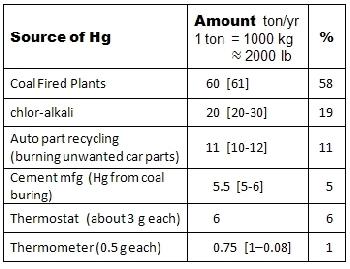
HgSource_tblThis table excludes any contribution by fluorescent lights. Let’s discuss where these numbers came from.   Errors here are my own, accuracies are due to the others. This study has not been endorsed by any outside agency.
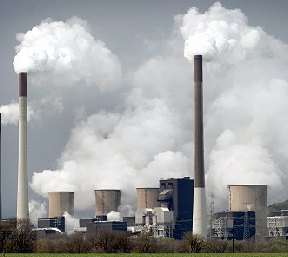
CoalPower_imgCoal Fired Power Plants   The largest source of Hg pollution is from our coal-fired plants, which means most of them. They generate 61 t/yr.        60 t/yr.

Although 58% of the entire pollution pool, the industry strongly fights against any changes from the cheap way of making power because the upgrades to filter Hg out of the exhaust plume are very expensive, making coal plants about the same as nuclear plants in installed costs.  The most amusing defense against exhaust filtering is the results would be solid or liquid Hg, and then we would still have to do something about that.

Chlor-Alkali This is from making chlorine products. These plants keep about 200 t in the processing inventory and typically “lose” about 10%,  20-30 t/yr.    20 t/yr.

Automotive Part Recycling Mercury is released as the unwanted car parts are burned; this accounts for 10-12 t of Hg/yr into atmosphere.   11  t/yr.

Cement manufacturing This is a problem because they burn coal to heat the kilns that process limestone. The published estimate is about 11,200 lbs, 5.6 t Hg released each year.   5.5 t/yr.

Thermostat OFF image

Thermostats  The old style thermostats contain about 3 grams of Hg each. These are being replaced by newer technology, and in 1997, Honeywell and two other companies formed TRC Inc. to accept and recycle old thermostats of any brand. By 2010, this had grown to a consortium of 30 manufactures; by 2005 had collected 2.5 t of Hg, by 2010 this had reached 4.7 t. Both numbers represent collection rate of about 0.35 t/yr.

TRC estimates that it collects about 6% of the thermostats that are being replaced:  (0.35t/yr)/0.06 = 5.8 t/yr must be sent to landfills everywhere in the U.S..  Round to   6 t/yr

A different source says that in 2002 the estimate from thermostats to landfill was 15 t/yr. If TRC was in error and its rate of voluntary recycling were 2.5%, the two estimates would be in agreement.
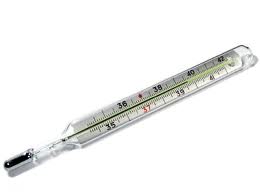
Thermometer_imgThermometers   This is not much of a be source of Hg, compared to the unregulated power industry.  But these things have been removed from sale all over the world.  Nowadays, everyone knows that, although it causes 1% of the total mercury pollution,  mercury thermometers are really, really, really  bad;  all our children are threatened.

A home thermometer (the type usually in the local bans that have been passed) contain about 1/2 gram of Hg.

I measured the bulb volume of my thermometer; using the low temperature density of Hg, the total quantity was very close to 0.5 g.

It is a challenge to find the associated waste volume.  There are literally millions of places to find information on how to recycle and why they are naughty to own.  I have had to generate my own estimates for the flow of Hg into the environment;  watoxics.org gives stating data.

In 2010, poison centers about the country logged in about 15,000 calls about mercury.  Assume 1% of the breakage occurrences resulted in a call.  This means about 1,500,000 thermometers broke in 2010, or 750,000 g, 750 kg, 0.75 t Hg from thermometers.  If the centers got 10% of the calls (extreme estimate), the lost Hg would be 0.075 t.

Check 2:  a thermometer holds about 1/6 the mercury in a thermostat.  My estimate is that a household would have one furnace thermostat and one thermometer.  If we had 6 t/year lost from thermostats to landfill, then we should see perhaps 1 t/yr from thermometers.  At this point, I would say that we are not looking at the total inventory of thermometers broken, so we should expect less than 1 t of Hg per year into the environment.

Check 3There are about 310 M people in the U.S., and about 113 M households.  Assume one mercury thermometer for every 2 households (some none, some more than 1).  So the inventory is ( g=grams, hh= households, thm= thermometers)

(113 M hh) (0.5 thm/hh) (0.5 g/thm) = 28 ¼ M g = 28.25 t of Hg in hh inventory.

Assume each household breaks and buys one every 20 to 30 years.  1 – 0.9 M grams Hg disposed of each year.  This is 0.9 to 1 t of Hg from thermometer disposal.    ♦ As a physicist, I am happy that is agrees with the other numbers within a factor of 2 (ball park estimates being what they are).     0.75 t/yr is a realistic estimate for thermometer waste.

This is a very approximate estimate, but it is probably close to the true waste value.  So 0.55 t to 1 t  is probably the right interval (0.75 is nearly the geometric mean of 1 and .56).

Fluorescent lighting

Ten years ago, tube fluorescents had 20 mg of Hg, they now have about 12.  At the turn of this century, CFLs had 6–10 mg, most now contain 3 mg.  Note that the cheapest lights probably have more Hg than these because reliable operation is easier.

First:  how many lamps does an “average” household have? One answer  is about 20. Another says 76.  Personally I would believe maybe 30 normal lamps.  The geometric mean is about 38. Let’s use 38.

Steady state: When all the households have changed out their 38  bulbs the sales volume will be for basic replacement, and the number purchased should be approximately the number discarded.  So we need to find the  proprietary number of bulbs  sold.

First approximation at number bulbs sold.   (38 bulbs/house) (113 M households) = 4320 M. Assume half are changed out each year, expect  number of around to 2 Billion bulbs sold each year, give or take some.

Best data  I have found is at realneo.us  in a comment by Kathryn Kranhold in 2007-Dec27  (columnist/blogger for the Wall Street Journal) titled His Bright Idea: Dominate Energy-Saving Light Bulbs.  She said that the 2006 sales volume for incandescent lights was 1.5 billion with 200 M CFLs.  Total is 1.7 B “luminaries” sold.  In 2010, the estimate was that 25% (1 in 4) of the sales were CFLs.  The true current sales numbers?  Probably somewhere between 1.7 and 2.0 ×10⁹ units.

Estimate discards  when the ILBs have phased out and everyone is buying fluorescent designs (equilibrium in 2015?),  I will guess the volume sold is 1 B units. Think this is twice too high?  You can divide the final results by 2.  Be careful with your correction factor, though.  If you divide the results (see below) by 1000, only 1 M bulbs would be sold and the manufacturing would dry up from loss of sales.  (model this – drop sales volume and raise prices to match … Indoor lighting becomes a rich-mans toy. I don’t even want think about that!)

We will be disposing of 1 B bulbs each year.  How many will actually be recycled?  If you say 100% you are in danger of utopian dreaming.  I use my home base, Ann Arbor, as an example.  The local drop-off center is a good drive from the center of the town.  It charges $3.00 entrance fee and $1 for each fluorescent luminary received.  Do not think 100% of Ann Arborites recycle.  Probably only  1–10% of the discarded bulbs will be recycled and 10%  is a lot higher than the recycle figure for thermostats with their 1000×  mercury content.  Ratios:  Recycled/discarded:   10%/90%,  1%/99%.

(1×10⁹ discards) (0.9 fraction dumped) (.003 grams each bulb) =2.7 M g of Hg
(1×10⁹ discards) (0.99 fraction dumped) (.003 grams each bulb) =3 M g of Hg

This is  2.7  ton/yr Hg from fluorescent luminaries entering the waste stream of the United States.

Discussion   Surely something is wrong with the estimate! This would mean CFL pose at least twice the hazard as mercury thermometers.    To get this down to the same ¾ t Hg/yr as thermometers, we need to divide the CFL waste by 3 or 4.

You almost get there by insisting on 50% recycling (divide by 2) but this has never before been met by any other commodity. And I would insist that the  3 mg Hg is too small, considering that fluorescent tubes used in businesses and manufacturing now contain about 12 mg each.  Maybe the geometric mean is the average we want … 6 mg per discard.  If so, then we return to 2.7 t.  Perhaps bulb sales are not currently 2 billion a year?   But if not, how could Wall Mart (a single retail seller) sell 100 M bulbs in a year?

I don’t think we can estimate better than 2 to 3 tons/yr of Hg pouring into the environment without someone doing a detailed study.  The results will probably be within  a factor of 2 to this estimate, though. The incandescent ban will add 2% to 3%  to the current mercury flow into the waste stream.  Yes, worse than thermometers.


____________________________________________________
Rare-Earth Waste
PhosphorElem_tblThis is not too controversial.  The inside layer of a tube is coated with the phosphor layer.  This generates the visible light.  It also contains may rare Earth heavy metals

An example of the kinds of materials is available from Osram Sylvania.  This table lists some of the most common elements.  I cannot carry this much further, because there is no listing of the chemical listing by weight for each of the phosphors used in common lighting tubes.  I have not seen any discussion of the effects of phosphor dispersal but there must be some.  Break a tube and you find white powder dusted about.  This is the powder and discarded tubes must have each element leached into the groundwater.

The Chinese experience demonstrates that  elements cause problems when dispersed at high enough concentrations.  Will we see water sources poisoned because of this?  We have to expect 900 M tubes discarded each year (same estimate as above).  Only actual testing would determine if contamination by rare earth elements will become an issue in the next 10 years.  I suspect that the actual weight of the phosphors (proportional to thickness of the layer) may be corporate secrets;  too heavy and visible light is absorbed, too light will cause a sunburn, if not actual eye damage (Fluorescents-5).


____________________________________________________
Summary

CFItrash_imgBy my “back of the envelop” estimate, disposal of CFL tubes poses at least twice the mercury threat as thermometers.  So why would we ban thermometers because they are so bad and push fluorescents because they are so good?  Neither should be our priorities:   Why not drop these 1 to 3% problems and go after the big problem worth 58%, the power generation industry and its unwillingness to upgrade?

The usual answer is because fluorescents save money.   Read Fluorescents-2.    If you leave CFLs on all day but switch incandescents off when not needed, CFLs cost more.     Keep both on all the time, never turn off any lamp, fluorescents are the spectacular winner.  If you turn them both off when not needed, you destroy the CFL long life spans, and lose.

An ideologue’s comment might be that we all just ought to do our recycling.  This is the  the sign of a utopian dreamer.  Many social activities have been proposed that would surely lead to a wonderful existence, if only we would all just  __ .  Actually, people in a community act in their best personal interests;  utopian dreams do not work.

We brought up a second environmental issue that I cannot estimate.  The phosphors that generate the visible light are loaded with rare earths, and are dangerous in the waste stream.  What will the dumping of all this new load of bulbs do to us?

click for a list of LastTechAge posts on illumination technology

Next post on fluorescents will summarize this long series, try to make a coherent pattern emerge.

Charles J. Armentrout, Ann Arbor
2011 Aug 16
This is listed under    Technology   …thread  Technology > Fluorescents
Have a comment? Click on the title of this post, go to bottom, let us know.
Related posts: Click the INDEXbutton under the Banner picture

Posted in Technology | Tagged , , , , , , , | Leave a comment

Fluorescents-5 Color of Light

This is the 5th post on fluorescent lighting, and covers short issues that can be examined fairly quickly.  Originally, we were to have 2 issues here, but the second will be a full post of its own.

Light Color

click for a list of LastTechAge posts on illumination technology

People have complained about fluorescent lighting for about as long as I can remember. The dissatisfaction grows from how the visible light is generated and how the eye interprets the light it receives.

Techniques have made certain fluorescent lighting choices quite acceptable, even very nice.  The final answer is that an FL lighting will never be able to precisely match incandescent, but has its own unique lighting shades.

IncanSpec_gph

Spectrum for Incandescent bulb is like blackbody at 2700 K

ILB lighting is generated by heating the filament.  The graph shows the color spectrum emitted by a hot object  (blackbody) at a temperature of 2700 K. As shown, incandescent spectra change smoothly across the wavelengths and are similar to to black body emission (with some wiggles due to the filament).

The emission for an object at 2700 K grows from nearly zero in deep blue (400 nm), brighter at red (650) and peaks at 1000 nm, in the near infrared..

PhosSpect_img

Spectrum of a phosphor. Rated 3500 K, Dotted BB at 4300 K

FL tubes generate visible light when the UV from its mercury is converted to colors by its phosphor layer.  The phosphor layer has a color temperature rating of 3500 K. The spectrum for blackbody at 4300 K is shown by the dotted line.

Phosphors emit visible light in discrete color bands (“lines”).  For this phosphor, orange (about 540 nm) is the highest intensity with peaks of lower intensity at shorter wavelengths, down to violet (400 nm).  The amplitudes of the spikes -sort of-  follows the continuous amplitudes of a spectrum generated by a heated object, (see next paragraph), but this particular phosphor is missing in the red, violet is a bit too small, and there is little emission between dominant color peaks.  The brightest intensity for a matching heated object (blackbody) would be deep red.   It would give the feeling of warm light with reddish overtones.  Our FL lamp would be more green with very little warm red.

Color temperature refers to the smooth spectrum of an object in thermal equilibrium. For the fluorescents which emit in discrete lines, it is terribly misleading.

The only possible reason we can accept fluorescent lighting is that our eyes do not see discrete wavelengths to way our ears hear sound wavelengths.  (With sound, we normally talk about its frequency rather than the related wavelength.)  What we see as rich vivid colors is what we would hear if our hearing perceived only a single chord of the same 3 notes, varying only in the relative intensities of those notes (the 3 visual “notes” would be blue, green and red). This is discussed in the Fluorescents-1 discussion of color temperature.

Color evaluation under FL lights can be confusing.  Attaching a “Temperature Color” value means only that the amplitudes of the dominant spikes tend to follow the curve of a continuous blackbody spectrum.  The temperature of this FL spectrum is rated at 3500 K.  You could find another FL  bulb rated at 3500 K whose spikes are as close to the amplitude of the blackbody curve, but have may have very high red lines, miss the green, might have another line in the blue.  Your eye would see big differences in the two phosphor net colors. Color temperature numbers for a  fluorescent light are an imperfect rating.

Color Rendering Index (CRI)   ALL attempts to compare spiky fluorescent spectra with smooth heat-generated light must be faulty because FL spectra are not smooth!  The CRI is another way to compare FL bulbs to incandescents using a scale from 0 (poor) to 100 (exact).  It is a good idea to have house lamps with CRI between 90 and 100, for human comfort.  This is another flawed standard, but it is the only one accepted internationally, and it will be used until a better one has been developed.

Good color, as with tasty food, depends on what you are used to. Here is a different explanation.  We may be used to incandescent colors, but will have to accept the spiky spectra as real and change our tastes.  Laws throughout the world are mandating the move from presumably energy expensive incandescent lighting.    Learn to change what you can but accept and be happy with the inevitable.

Summary

click for a list our posts on illumination technology

Color labels for fluorescent lights is imperfect. Most people are more comfortable with red tints in the lighting used about the house.  Because of the difference between continuous spectra and spiky spectra,  there will never be a good comparison between visible light emitted by a heated object and visible light emitted by a phosphor screen.  They are fundamentally different processes.

Is one color better or worse than the other?  No, they cannot be compared, you just have to acclimate yourself to the new lighting.  Fluorescents are hard to match between brands because each one has its own phosphor screen compounding.  Too bad you cannot specify replacement lamps by their phosphor. The phosphor screen is the source of lumen depreciation that dims all fluorescents, as pointed out in the last post.

You get a draw if you use color to compare fluorescent and incandescent lights.  Next time, we will look at environmental concerns,  mercury and other heavy metals that can leach out of the tube and into the outside world.  That may help more.

Charles J. Armentrout, Ann Arbor
2011 Aug 14
This is listed under   Technology    …thread    Technology > Fluorescents
Have a comment? Click on the title of this post, go to bottom, let us know.
Related posts: Click the INDEX button under the Banner picture

Posted in Technology | Tagged , , , , , , | Leave a comment

Fluorescents-4A: Flicker and UV

This is the fourth post in a series about compact fluorescent lights (CFL).  We look at a number of different issues that have been raised, some may be true problems, some almost certainly are not “show stopper” issues.  CFLs will be our lest expensive choice for bright light bulbs in the U.S.,  starting January 2012.

The first post discussed mechanical longevity of the CFL bulbs; the second discussed frequent switching and what it does to the estimated life time costs of these very expensive bulbs;  the third discussed the loss of intensity as the bulb ages or as the temperature changes from its optimum value.   Here, we look at 2 concerns, lamp flicker and UV emission.  Part 4B will look at lamp color and environmental issues.

Flicker

Fluorescents have had a bad reputation because they rapidly blink on and off, sort of like a motion picture image.  The reason is that fluorescent lights go dark when the driving voltage is zero.  The blinking was too slow, and some people get/got massive headaches when working under fluorescent lights.  This was such an issue that during the last decade, many state electrical codes were changed to specify the maximum ripple in brightness that would be allowed for a fixture.

All this was due to the magnetic ballasts (that also need starters) in use until just recently. Power line AC voltage goes to zero 120 times a second (North America) 100 times in other places (twice line frecuency) and magnetic ballast output goes to zero is sync with the power.    Incandescent lights does not display this problem because the glowing filament stays hot and emitting, even during the millisecond or so when little or no heating current flowed.

With the generation of tubes and bulbs released in the past 5 years, the magnetic ballast was superseded by the electronic ballast.  In these circuits, the switching frequency is 40 thousand times a second or higher.  Human response is much slower than 40 kHz,  and to the best of my knowledge, no one gets headaches anymore.

Ultraviolet light  (UV)

UV radiation from fluorescents is well known.  Here is a 2008 Oct 09 report on this topic by the UK Health Protection Agency, copyrighted in 2011 .  You occasionally will run across warnings about exposing plastic and rubber items to prolonged CFL exposure. Read How Fluorescent Lights Work.

Voltage supplied to an FL tube does two things.  1.  It causes electrons to boil off due to the heated filaments. 2.  It accelerates the electrons through the mercury vapor, exciting the atoms to emit UV light which is the principal emission from the tube.  The UV is absorbed by the phosphor layer on the inner walls of the tube and (lower energy) visible light is emitted into the external world.

If the phosphor layer is too thick the visible light can not get out of the tube.  If it is too thin, bright visible light will be generated, but a significant intensity of UV will be allowed to escape into the room.   The manufacturer’s tendency is to make the layer thin, to save costs.   If the tube was not pre-cleaned properly,  even thick phosphor layers will not adhere to the glass wall and spots will appear where the UV can freely escape.

CFL-Sunglasses_imgUnderstand, this ought to be an issue primarily for those with UV sensitivity.  But … if the bulb has been manufactured with little regard to the end user, we will find batches of dangerous bulbs with even visible holes in the white coatings, UV spigots anywhere along the tube.  Note that most tubes/bulbs are made in China.  What kind of inspection does your country do for imported fluorescent lighting?

Summary

click for a list of LastTechAge posts on illumination technology

My main worry in all these posts is that all our fluorescents appear to be made in China.  Here is a wonderful opportunity to rake in the profits for the plant owners –  those people who were young ideologists during the Great Leap Forward years, the leaders of the gangs who intimidated the populace.  We will see many really cheap bulbs and great confusion.  I suspect that we will see in upturn in UV related health issues that will be blamed on solar exposure.    The other issue, flicker, is now dead; fast response by industry since state regulatory laws are themselves only perhaps 5 or 6 years old.

Stay tuned.  Next time, same place same blog, we will look at mercury and other environmental contaminates

Added In Final Proof:   The New York Times had an interesting article this morning (Thursday, 2011 Aug 11) in their HOME section.  Bob Tadeschi (The Pragmatist) writes it is about time to change lights.  He has a number of points, one is that only the 100 W bulbs cannot be sold after the start of 2012 and final phase out of our incandescent history will take 2  years to complete. Another of his points is that you can easily buy cheap bulbs that don’t do not’n’.  He says brands are very important (“very” is my adjective) and CFLs can be disappointing and very confusing, considering the many different types you would need about the house.   He does say these things will last maybe longer than you are in your house, but did not add that you must buy the most expensive brands and must be willing to live in a house with significant light dimming to accomplish this.  He does talk about the other options to meet special needs (that are much more expensive right now).  All in all, a good article to read!

Charles J. Armentrout, Ann Arbor
2011 Aug 11
This is listed under    Technology   …thread   Technology >  Fluorescents
Have a comment? Click on the title of this post, go to bottom, let us know.
Related posts: Click the INDEXbutton under the Banner picture
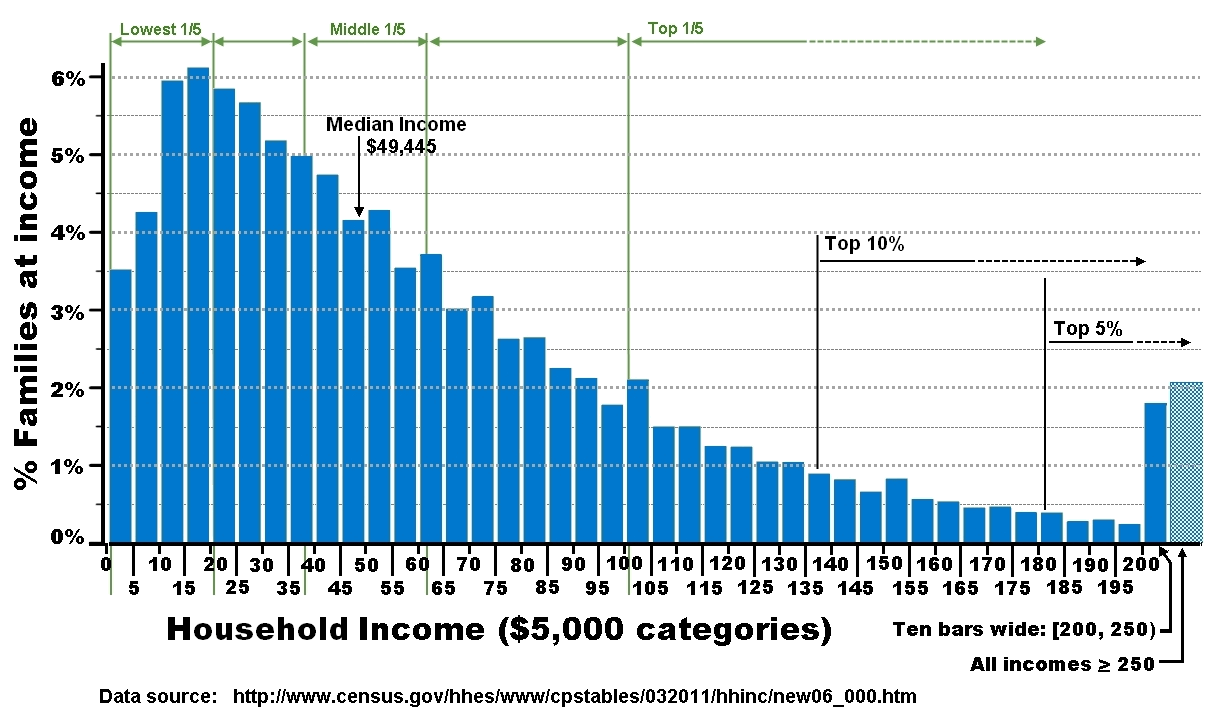
Posted in Technology | Tagged , , , , , , , | Leave a comment

Fluorescents-3: Not as bright as you think

Compact fluorescent lights (CFLs) are mandated for the US market starting in January 2012.   These bulbs certainly have good press;  they are reputed to do wonderful things, nice green attributes.   Here, we discuss probably the most serious problem with the CFL mandate:   how brightness wears out for CFL bulbs.

Fluorescent lights lose brightness.

For her garden, my wife plants seeds in our basement. She uses fluorescent tubes and the seedlings usually grow really well.  The problem she noticed was that every 3rd or 4th year the seedlings would have real problems – they developed symptoms of light deprivation, though bathed in light.  They died.

That is how I learned that each four foot lamp had to be replaced every 3 years.  I notice that the post-change light is much brighter than the pre-change.  Let’s see: 10 hours/day from February to May, 15 weeks × 7  days × 10 hours × 3 years.  Initially, these tubes were bright enough to keep the plants alive and healthy.  They lost the brightness (their initial lumen value dropped to unusable levels) after no more than  3500 hours.   The tubes were rated for 12 000 hours.

Misconception #1 — Fluorescents are good for their rated lifetime. Turns out, lifetime means the time from first turn on until 50% have broken due to mechanical or electrical faulures.  That is, before their “rated lifetime,” half will have failed.  It certainly does not mean things will live under them for that time.  They get dimmer and dimmer as they age.

Lamp Lumen Depreciation (LLD )    All lamps dim as they age.

LLD-incand_gph

LLD for incandescent lapms

Incandescents  lose intensity because the tungsten filament boils away and plates the inner surface of the bulb, becoming a light barrier.  Data source here.  Tungsten halide bulbs stop this.  Fill the bulb with inert gas such as xenon (Xe) and add small concentration of iodine (I) or bromine (Br). The gas stops the tungsten wall coating and redeposits the atoms back onto the filament, and adds to lifetime.

Tungsten halide bulbs show very little lumen depreciation!  Both types of incandescent bulbs are usable up to mechanical failure.

LLD-CFL_gph

LLD for CFL bulbs

Fluorescents  lose intensity mostly because of the chemical changes in the phosphor coating on the inside walls. The absorption of the Hg ultraviolet emission and re-emission of visible light is due to the molecular structure of the coating, which will become disrupted with addition of stimulus energy.  (I personally ran into this when I developed special imaging equipment.)  Data for CFL bulbs are proprietary and hard to find; this is “typical” data published by the U.S. DOE. Click to read how phosphors work

Long straight FL tubes used in business have LLDs  are better than this figure for CFL bulbs.  But recall that my seedling lamps used FL tubes, not CFL bulbs and had become unacceptable after 3500 hours.  The ones that with the 2012 mandate are the CFLs with the unpleasant lumen depreciation.   I suspect the the problems are related to the narrow bore of the CFL tube.

Dust_gph

Dust causes additional lumen loss

Dirt Accumulation 
All lamps dim as dirt builds up.

Dust settling on the bulb will cause dimming in addition to LLD effects.

This graph is from data, but the actual light dimming for your bulb will depend on the dust/dirt in the ambient air.  Multiply the LLD for your bulb  by the dimming due to dirt (0.84 after 48 months of not being cleaned).  This is the total light loss you will experience.

Ambient Temperature Effects 
CFL brightness declines at high and low temperatures.

Lm-Tmp_gph

Lumens and ambient temp

All FL bulbs have their maximum brightness at a specific temperature.  The curve of Lumens vs Temperature varies a lot from type to type; some bulbs are designed to run at cold temperatures, some at high temperatures.

The fall-off with temperature is pretty rapid.  Suppose the bulb is brightest at 25º C (77º F) as in the graph.  At 50º F (10º C), the brightness will be about 20 % less than the optimal temperature.  This will be true for brand new bulbs and ones near the end of their emission lifetime.

Cold tubes that operate below freezing (0º C) usually peak at or below 20º C and and are below rated intensity at 30º C.  All bulbs I have been able to find might work at very cold temperatures, but are well below peak emission and not at all bright.  There are tubes that are bright above 40º C (about 100º F) and these will be unsatisfactory at cold temperatures, may not even turn on.

These cold ambient and hot ambient tubes use special electronic tricks to make the light work, usually inductive pulsing or rapid switching, both of which will shorten the bulb mechanical lifetime from that quoted for room temperature bulbs.

In the future, we must have many different replacement stocks for the lights.  One pile for room temperature CFLs, another for Attic CFLs that work at high and low temperatures,  and yet another stock of outside CFLs that have to work in very cold temperatures.  Double this because in many climates, your outdoor fluorescents must be stocked in separate winter and summer groupings.  I predict that this change-out will become a pain in the neck.

A side effect of this temperature dependence is the orientation of the bulb with regard to its base.  The electronic ballast is in the base and degrades or misfunctions  at high temperatures, so you must have all the stockpiles above divided into at least 2 more categories:  bulbs put into that are screwed upright into normal lamps, and bulbs that are screwed into ceiling lights that have their bases above the light or horizontal and are in sconces.  There will be a lot of money tied into stock to keep the house/apartment running.  In the U.S., this puts a new meaning to CFLs as a “green” issue.

Summary

click for a list of LastTechAge posts on illumination technology

We must convert to CFLs by this coming January.  This is a done deal.  We will probably find we pay a bit more for power (around the house) but the real issue will be failure due to localized heating about the bulb, heating outside specified ranges. A second frustration will be the incessant dimming of each bulb used.  Did you count up the many categories  you will have to consider when you select bulbs for the different the locations around you?

Incandescents are the clear winner in the lumen depreciation face-off.  Tungsten-halogen bulbs have very little brightness fall and lifetimes close to CFL bulbs.  They also work well in almost all environmental conditions.

CFLs are easily hyped, will they be comfortable to live with?  Or have we discarded an important technology in favor of a Bumper-Sticker Green one?

Charles J. Armentrout, Ann Arbor
2011 Aug 9
This is listed under     Technology    …thread   Technology > Fluorescents
Find related posts on
INDEX  tab, under the Banner

Posted in Technology | Tagged , , , , , , , | 1 Comment